



Gord Magill’s grandfather landed at Juno Beach three days after D-Day. His father is still on the road at seventy. Gord started driving at eighteen.
This week I spoke with Gord, a third-generation Canadian trucker and author of End of the Road: Inside the War on Truckers. He’s 47, lives in Ithaca with his wife and two daughters, and is mid-naturalization to become an American citizen. In January 2022 he drove to Ottawa to welcome the Freedom Convoy and wrote about what he saw for Newsweek.
We talked about the Freedom Convoy. About what really happened to truckers in 2022. About why the same forces that came for his industry came for our schools.
Gord gave me permission to share the opening chapter of his book with you. It’s called “A Family Tradition.” It looks back at his trucking history and how things have changed. You’ll find it at the end of the transcript below, for paid subscribers.
If you read us for free, please consider going paid this week. Paid subscriptions fund our investigations, our films, and our work at Restore Childhood.

Our conversation below has been lightly edited for clarity.
Natalya: Here in the United States, even with your Newsweek pieces, if I mention the trucker convoy I think most people’s eyes glaze over. They have no idea. It was really not reported except in alternative media. Can you start at the beginning and tell us what the trucker convoy was?
Gord: Right. I’m going to assume most of your audience hasn’t totally memory-holed COVID and everything that happened during that time. It was bad in Canada. It was bad in a lot of parts of the United States, but it was worse back home. I traveled home during the troubles, because the border wasn’t completely closed and they had to let me in as a Canadian citizen. So I went back a few times before the Freedom Convoy and saw how utterly ridiculous and nonsensical the impositions in Canada were. And that’s coming from New York State, which is saying something, because they were pretty ridiculous here too.
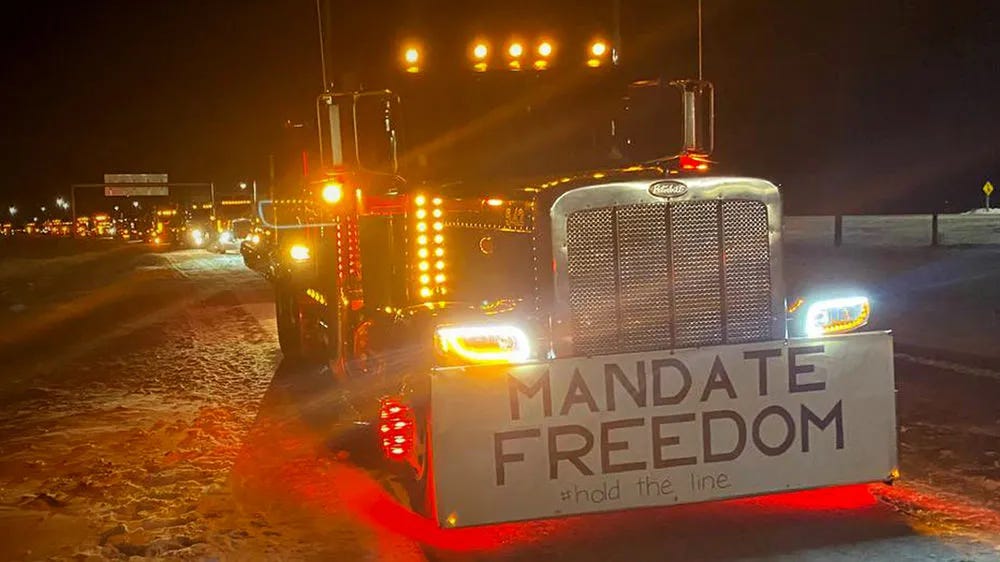
When I heard about the Freedom Convoy I felt very strongly that these guys needed every last voice. One of the really depraved things Justin Trudeau had done, over and above publicly using vile rhetoric to describe COVID dissenters, calling anybody who disagreed with his policies racists and homophobes and asking whether we should tolerate these people, he actually enacted legislation that actively discriminated against us. In Canada, any federally regulated area of life, you were subject to having to show a vaccination card. You were not allowed to travel. If you’re a native person who lives in the far north of the country and you need specialist medical care in Toronto or Winnipeg or Vancouver, that means an airplane. If you didn’t take the juice, you weren’t getting on the plane.
It got really bad. In November of 2021, the federal government in Canada and the Biden administration began discussing mandating vaccines for cross-border truckers. If you’re not a truck driver and you don’t understand how the industry functions, you might not understand how utterly ridiculous and unnecessary this was. Truck drivers lead solitary lives. They sit in the cabs of their trucks most of the day. Maybe at the truck stop, maybe at a rest area, maybe at some facility where you get loaded. But during COVID, most of those places were closed. When truck drivers would go to the mill to pick up a load of toilet paper, the personnel at the mill wouldn’t let drivers in. Just back your trailer into this door. Don’t come in for your paperwork. Don’t do anything. We’re doing it all electronically. You’re not allowed to use our washroom facilities, stay in your truck.
So during COVID, there’s less opportunity to interact with the public than ever. Truck stops closed or on reduced hours, rest areas closed (very famously the Pennsylvania Turnpike), and you got treated like a leper everywhere you went. On top of that, the government in both countries issued what are called HOS waivers. Truck drivers normally work 60 to 70 hours a week as standard operating procedure. The government said, well, there’s a national emergency and we have to keep supply chains moving, so if you’re hauling COVID-related goods you can work 100 hours a week and we won’t bother you. So truck drivers were tasked to work twice as hard as they normally do. No facilities. Treated like a leper everywhere they went. And now on top of it all they’re going to make you get a vaccine, even though you’re not interacting with anybody, you lead a solitary life in your truck, and you’re working very hard to keep the economy going. None of it made any sense.
In Canada, this spontaneous thing called a slow roll developed. The idea came from a lady named Brigitte Belton. Originally it was, hey, let’s have a slow roll to Ottawa, drive our trucks down the 401 nice and slow as a protest action. That was the seed of what later became the Freedom Convoy.
Natalya: Where were they driving from?
Gord: Originally Brigitte’s from Ontario, but the idea was that any truck driver who wanted to participate could do a slow roll wherever they were. Just get on the highway, drive slow, block traffic, let your concerns be heard. Over time it grew and spread. A bunch of truckers in BC, a bunch in Alberta, and then later all across the country said, let’s go to Ottawa. It started to organize in people’s kitchens via Zoom meetings, then on TikTok and social media. It was super viral, super spontaneous, super decentralized. There was no central committee of the Freedom Convoy. There was no money directing anything. There were no donations until after it already started heading for Ottawa. It was basically out of people’s pockets.
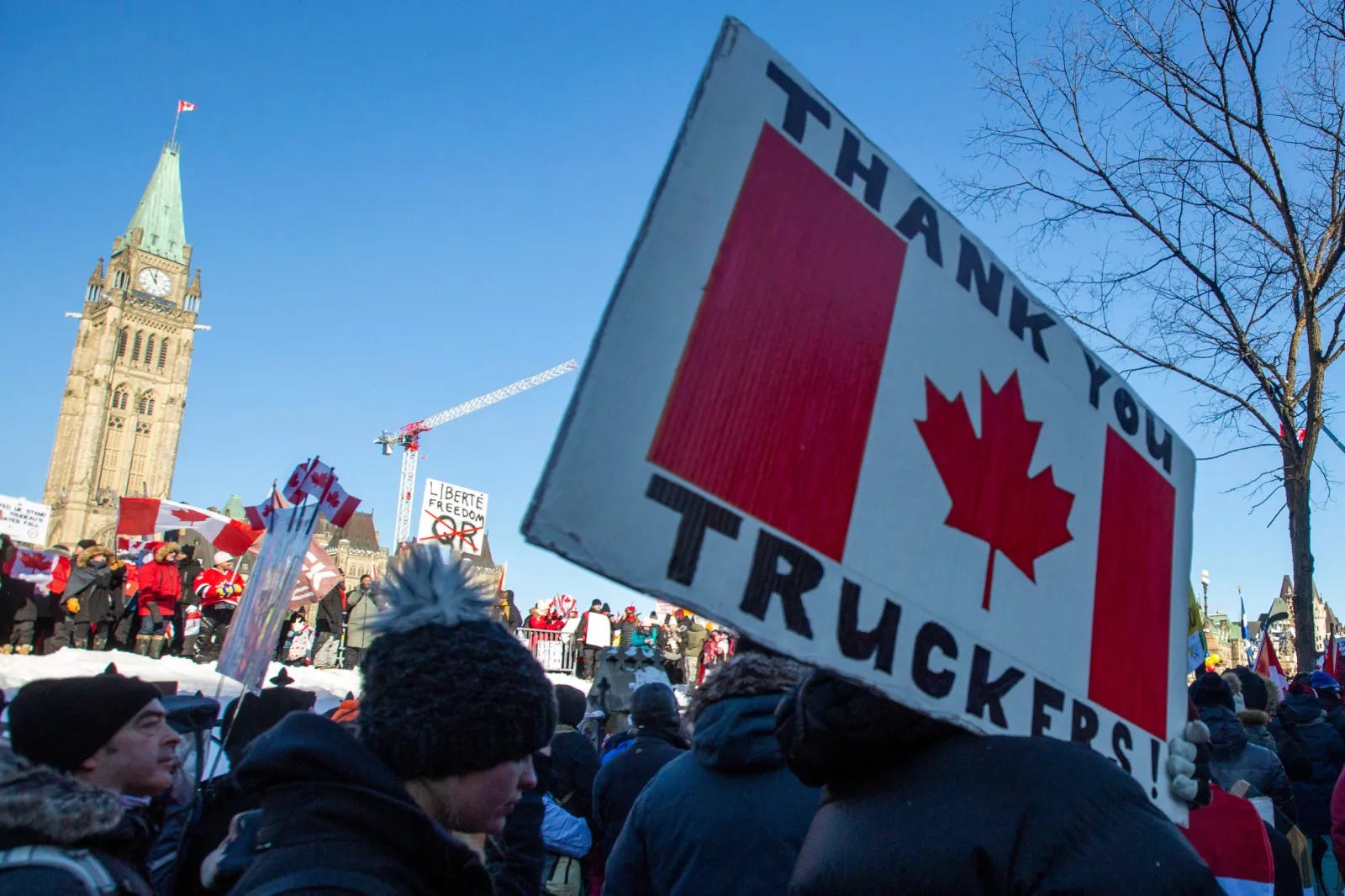
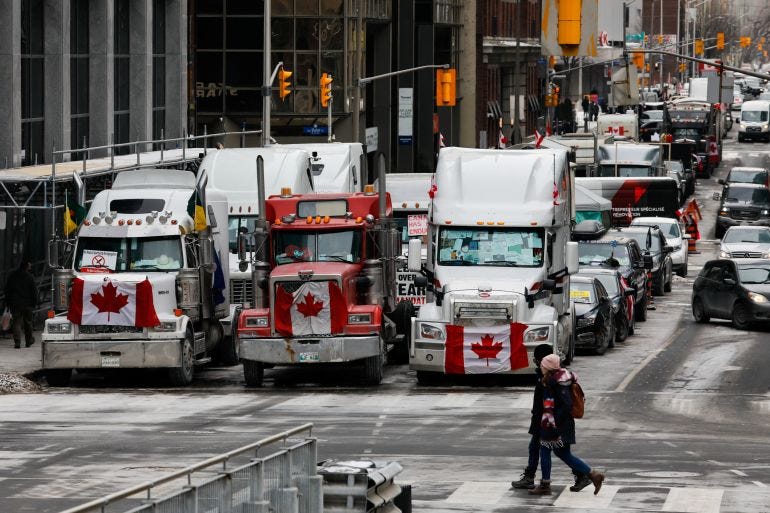
In the end, 13 different convoys from all across the country went to the nation’s capital. The one from Western Canada took a few days to drive across the country, and as they went, people lined the overpasses, came out to greet them. That was the Freedom Convoy. They got into Ottawa. I was there that first weekend. There were thousands of people all over the capital, at Parliament Hill, trucks parked all over the city. They settled in. It was a three-week-long protest, totally peaceful.
The media immediately started saying things about the convoy that were scandalously untrue. The convoy is stealing food from a soup kitchen. They’re harassing people in the streets. They lit an apartment building on fire. They’re peeing on statues downtown. All of this was later proven to be totally bogus.
Everybody remembers that after three weeks of protest, Prime Minister Justin Trudeau invoked something called the Emergencies Act, which is secondary legislation after something much older called the War Measures Act. It’s only millimeters away from being essentially martial law. He used it to clear out what was at that time the largest peaceful protest in Canadian history.
As part of that legislation, there’s an automatic inquest, because it’s considered so severe. You invoke it, you have to have an inquest later. It’s called the Public Order Emergency Commission. During that inquest, it was found that all the things the government and the media were saying about the convoy were untrue. The director of intelligence for the Ontario Provincial Police, a key player in managing security in Ottawa and trying to figure out the convoy, told the POEC that the media and the government lying about things made it very difficult for them to do their jobs. The truckers got annoyed at the cops. Meanwhile, anybody who could go outside and actually see the convoy, and I was there, could see it was people running around hugging each other, waving flags and signs, saying, hey Trudeau, come talk to us.
For the American listeners: Prime Minister Trudeau, within hours of the convoy coming to town, left Ottawa. He went and hid at a cabin in the woods in Quebec for several days. He memed himself into believing the truckers were going to storm his house and attack him. What was found at the Public Order Emergency Commission is that members of the Canadian government and the media were collaborating to set a narrative. They started calling it “January 6th North” before the truckers even got to Ottawa. They were already running a media campaign to smear them and compare them to the protests against President Biden, trying to imply the truckers were violent fascists. Again, all of it disproven.
Three weeks later they cracked down on the convoy, smashed people’s trucks, towed them away, beat protesters in the street. Very famously, a Canadian reporter named Alexandra Lavoie had a tear-gas canister fired at her at point-blank range. A Royal Canadian Mounted Police horse trampled an old native lady in her wheelchair. They’d beat people, throw them in vans, drive them 30 miles outside of Ottawa, drop them off in the cold. All kinds of really bad stuff. And the amount of violence or criminality engaged in by the convoy was zero.
Natalya: It seems very similar to what happened to dissenters here during COVID, where Fauci and Collins ordered a swift and devastating takedown, which is now documented in discovery from a federal case. It seems almost like this was orchestrated from somewhere else.
Gord: Yeah, almost. One thing a lot of Canadians don’t know, and basically no Americans know, is that the American government was heavily involved in Trudeau’s decision to invoke the Emergencies Act. They were demanding that the border crossings that had protests slowing down freight between the two countries be cleared. There was a number of phone calls between Biden and his people and the Canadian government. It was revealed later that the pressure was coming from Washington.
Canada’s banks were talking about labeling the truck drivers as terrorists without any evidence and freezing their bank accounts as a method to get them to leave Ottawa. At no point in this protest did the government say, hey, maybe we should talk to these folks. No envoy. Trudeau never sent his underlings to the leadership that did eventually develop around the Freedom Convoy. Because, again, it was originally spontaneously organized with no leadership.
I want to share something with your audience about a difference, and I’m not trying to be political about right versus left or political party here. I recently went to the Mid-America Trucking Show in Louisville, Kentucky, at the end of March. It’s an annual industry conference, the biggest trucker party in America, and also a serious gathering. Lots of products, discussion from regulatory agencies, corporate people, insurance, everybody involved in trucking is there.
The trucking industry in the United States has been going through convulsions since COVID, because of policies engaged in by the Biden administration that built on policies changed before him. It’s all grown into a big mess that involves holes in the regulatory system mixed in with mass migration mixed in with corruption in the issue of CDLs. Now we’re seeing a humongous spike in collisions and crashes on the highways. Innocent people being killed.
Anyhow, who shows up at the Mid-America Truck Show this year? United States DOT Secretary Sean Duffy. Head of the Federal Motor Carrier Safety Administration, Derek Barrs. Barrs was there for the whole three days of the conference, talking to anybody who wanted to talk to him. Truckers in America have been getting together for a couple of years now to say, hey, we have a problem. On social media, in regular media, everyone’s trying to talk to the government: we have this problem in the industry, can somebody please sort this out? President Trump sends his guys directly to the biggest trucker party in the country.
Canada: the truckers say, hey, this mandate is stupid, you’ve never provided any scientific basis or evidence for it, we’ve been working our butts off to keep the economy going during this national crisis and you want to kick us in the ass for it, please help. What did they do? They crushed them, froze their bank accounts, seized their trucks, and spent four years since pursuing a whole bunch of them with lawfare. They tried to seize Chris Barber’s truck after the fact. There’s been hundreds of cases of people nobody knows about having to go to Ottawa to face mischief charges simply for showing up at a peaceful protest. The Canadian government has spent tens of millions of dollars on court resources, lawyers, fees, ruining people’s lives, for taking part in a peaceful protest where they said, please talk to us about this problem.
Natalya: So who does that benefit? Does that benefit Canada? Because I saw your new prime minister talking about the new world order and how Canada and China were very much aligned. After having made a documentary about the school closures and watching very closely as the teachers’ unions have very successfully destroyed the fabric of this country and still hold all of our children hostage, I can only come to one conclusion: they’re foreign agents serving another government, because nothing they do benefits anyone in this country in any way. And everything you’re telling me, it’s a different stage, a different population, a different country, but it’s the same playbook, and it doesn’t benefit your country in any way. Canada pre-COVID was Shangri-La. Everybody dreamt of being a Canadian citizen, at least from our perspective. I’m a Soviet immigrant. My parents always talked about Canada as this amazing country. I know you had your problems, always had, but compared to what it’s become in such short order, the only thing I can see is foreign goals being served.
Gord: Mark Carney is a special one. He was an advisor, one of Trudeau’s economic advisors, and he wrote an op-ed in Canada’s biggest newspaper a few days before the invocation of the Emergencies Act telling Trudeau he should invoke it and deal with the truckers.
What a lot of people don’t know is that Trudeau’s invocation of the Emergencies Act was taken to court. A number of civil rights groups and individuals sued the Canadian government and said, you infringed on our Charter of Rights and Freedoms, Canada’s version of the Constitution. We want the courts to rule on this. That came down in early 2024. Federal court justice Richard Mosley ruled against Trudeau and said the invocation of the Emergencies Act was unjustified, unnecessary, unreasonable, and you broke Canadian Charter rights to peaceful assembly, freedom of expression. You basically trampled everything.
Twelve or 14 or 15 minutes later, the government filed its appeal. So this is a 2,000-page ruling from a federal court justice, and the government already had an appeal locked and loaded ready to go. They knew it was coming. That appeal goes through the courts for two years, and then the ruling on the appeal of the Mosley decision comes down. The appeal says: no, it stands. You guys trampled everybody’s rights. The government was in the wrong.
After that appeal, the government has 60 days to do anything with it. On the 60th day after losing on that first appeal, Mark Carney’s government appealed it to the Supreme Court of Canada. So we’re going to be relitigating this Freedom Convoy thing until who knows when, because they don’t want to be told they were wrong.
Natalya: It’s really, you said something about lawfare and this country has seen its share of it. I don’t know if you’re familiar with an interesting case with regard to gender, Eithan Haim in Texas, a young surgeon who blew the whistle on Texas Children’s Hospital for the fact that they were implanting puberty blockers in children as young as 11.
Gord: I did hear about that.
Natalya: If President Trump had not won, Eithan would have been in jail for at least 10 years. The DOJ had gone after him, filed case after case after case, and the goal was to send a message.
Gord: Right.
Natalya: Everything you’re telling me about the government’s actions, it’s beyond just clamping down directly on civil liberties and on the truckers. They used the truckers to send a message to the rest of the people. Don’t think about this, because this will happen to you. We will come after you. And surely your media didn’t show what was really happening?
Gord: Never did. The people who lost the most from all of this in Canada were the media. In 2019 they were already losing money: the internet, social media, alternative media. A group of very large media conglomerates in Canada came to the government and said, we’re losing our shirts. The Trudeau government gave them a $600 million subsidy in 2019. That’s over and above already paying for the CBC, the Canadian Broadcasting Corporation, a crown corporation paid for by the taxpayers, already a billion-plus a year. Since 2019 they’ve received several top-ups. And then last year Carney announced more subsidy money for the media.
So the media, going back to your question about sending messages: for four years the Canadian government spent tens of millions of dollars pursuing frivolous cases of mischief or intimidation.
When the sentencing came down for some of the convoy organizers, they got house arrest. The judge basically said, okay you guys, you’ve had enough, but we have to give you something. So 15 months of house arrest for one, 18 months for Chris Barber. You’re allowed to keep working because you own your own company and you have to keep trucking. A slap on the wrist.
The Canadian government, at least the province of Ontario, immediately filed an application to seize Chris Barber’s truck. His W900 Kenworth, that is the center of his business, that he uses to feed his family and serve his customers. They said, we’re coming for your truck. Because that truck had become a symbol of the Freedom Convoy. It’s in photos everywhere. It led the Western Canada convoy into Ottawa. A big beautiful red truck with the white maple leaf on the hood. Really well taken care of. Chris is an awesome trucker, looks after his equipment. It became a symbol, and the Canadian government wanted to crush the symbol. Again, the messaging: don’t fight back, we’re in charge. They went to such lengths that they wanted to take this guy’s truck and destroy it. Eventually, after months and months of that fight, the government was told no, you can’t take Chris Barber’s truck. So the Canadian government has lost on a number of fronts. But does the media make a big deal of that? They don’t want to bite the hand that feeds.
Natalya: Of course. It’s exactly their MO, right? Crushing individual voices is the goal. Sending a message by doing it to a couple of them is exactly the goal. The most threatening thing to these totalitarians is just ordinary people speaking out. People always ask me, what can I do, how can I join the cause? I’m like, you can speak up. You can stop self-censoring. That’s what I’ve always tried to convey through whatever we cover or write about, even our documentary. There are small voices. You don’t have to have a big capital-V voice. One op-ed. I sued the New York City Department of Education and the mayor.
Gord: The most prominent libertarian guy who stuck with the truckers was Jeffrey Tucker. Jeff Tucker was the only big-name one. Reason, Cato, all the institutional DC libertarians were asleep at the wheel.
I want to relay one more story from Canada. There were four other guys at one of these Freedom Convoy protest sites, at the border crossing of Coutts, Alberta, coming into Sweetgrass, Montana. There was a protest site there. The government basically raided that place. There were accusations of, oh, there are all these guns stockpiled, they’re going to cause a revolution, get violent. They arrested 13 people. Four of those 13 went to jail, two of them for four and a half years.
Natalya: How long was Tony Olienek in jail?
Gord: Almost four years. They basically took these four guys and put them in jail. All four were regular working-class people. Tony Olienek, a truck driver, ran a gravel quarry with his dad. Chris Lysak, an electrician. Jerry Morin, an electrical lineman. Chris Carbert, an independent businessman with his own landscaping company. All young, normal working-class dudes who did nothing except show up at a protest. The government concocted a conspiracy theory against them, a conspiracy to murder police officers. When they applied for bail, the government denied them bail, even though they were no flight risk. None of them had a criminal record. They all had jobs. They all had people standing up for them. Nope, you’re staying in jail.
It turns out that one of the federal justices in Alberta, this woman whose name escapes me, had donated to the Liberal Party of Canada something like 27 times. And she denied them bail on multiple occasions. Seventy-seven percent of the justices, the entire bench across the country, are appointees of, or members of, or donors to, or all three to the Liberal Party of Canada.
The justice system in Canada is totally a political arm of something we call the Laurentian elite. There are two elite groups in Canada that are the power centers in Canadian society. The Laurentian elite, that’s the old power elite in Toronto, Ottawa, Montreal. They run the media, the government, what Curtis Yarvin calls the cathedral, a number of old-school corporations. The other elite is in Alberta: agriculture, oil, energy. The Laurentian elite are pervasive in every aspect of the management of Canadian society, and they use the justice system against their own people to maintain that power and to send messages.
Natalya: In this country, as you said, we have President Trump, and I always feel like, there but for the grace of God we would be with you as well. He’s not perfect either, but I can’t imagine how someone could be. I’m a former progressive Democrat. I had total Trump derangement syndrome when he won the first time. I was devastated. I apologized to my young daughters afterwards. I was so pompous and arrogant. I bought everything the media said. When he said fake media, I was just appalled. My New York Times, how could that be fake? It was my whole value system.
Through COVID, the silver lining of all that, and I would have preferred not to put our children through it, but it definitely showed what was happening and how we’d been misled. Of course Trump is not perfect, and he’s got his own skeleton closet, but the president of a country, a politician who makes campaign promises in order to win an election, is not going to be Jesus. So I’m okay with that. I don’t have a litmus test. I don’t care about his personality.
I was a huge DeSantis supporter. I loved what he did in Florida. I still think he’s been pretty close to perfect, there are certain things where he’s clamped down a little too hard, but overall he seems like a really good guy with a great moral compass. I used to be on Fox & Friends pretty regularly during the last election. They would bring in progressive Democrats to try to get them to say they’d vote for Trump. I never did. I knew it was the kiss of death. I’d say, well, I’m going to vote for anyone but Biden. And they’d say, what if it’s Trump? And I’d say, not Biden, you know, whatever. I wouldn’t give them the soundbite.
Pete Hegseth, who’s now our Secretary of Defense, was an anchor on it. Really nice guy. Would come backstage and talk to the guests afterwards. I remember him talking about President Trump, who was running against DeSantis in the primary at the time. I’d say, no, no, no, I’m very much pro-DeSantis. He was talking about how DeSantis didn’t have much of a bedside manner. Wasn’t really the most social, charming, enigmatic person, which I think is fine. He’s still doing a great job. But Trump has that connection. He’s untethered, and sometimes it’s insane, unhinged stuff, and sometimes I’m like, yes, that’s our president.
Gord: He’s got good people skills, love or hate some of the things he says. Again, the truckers in America expressed a concern, and he sent his guys to go talk to us. During the Freedom Convoy, President Trump was very vocal in his support, “those great Canadian truckers,” and he understood that the Canadian government had gone too far.
The Canadian government are very cold managerialists. I think one of Trump’s errors was playing into the last election in Canada. He said some things that helped with the Liberal Party’s pivot away from Justin Trudeau’s record. The last election in Canada was no longer about Trudeau. It was about President Trump. That played to the TDS in the minds of a lot of CBC Canadians. And then the Conservative Party guy in Canada, Pierre Poilievre, dropped the ball on that real bad and proved himself not to be the man of the hour. So there’s blame on all sides.
Natalya: You think if Pierre Poilievre had won, Canada could be in a better position now? Or do you think the institutional powers are just too strong anyway?
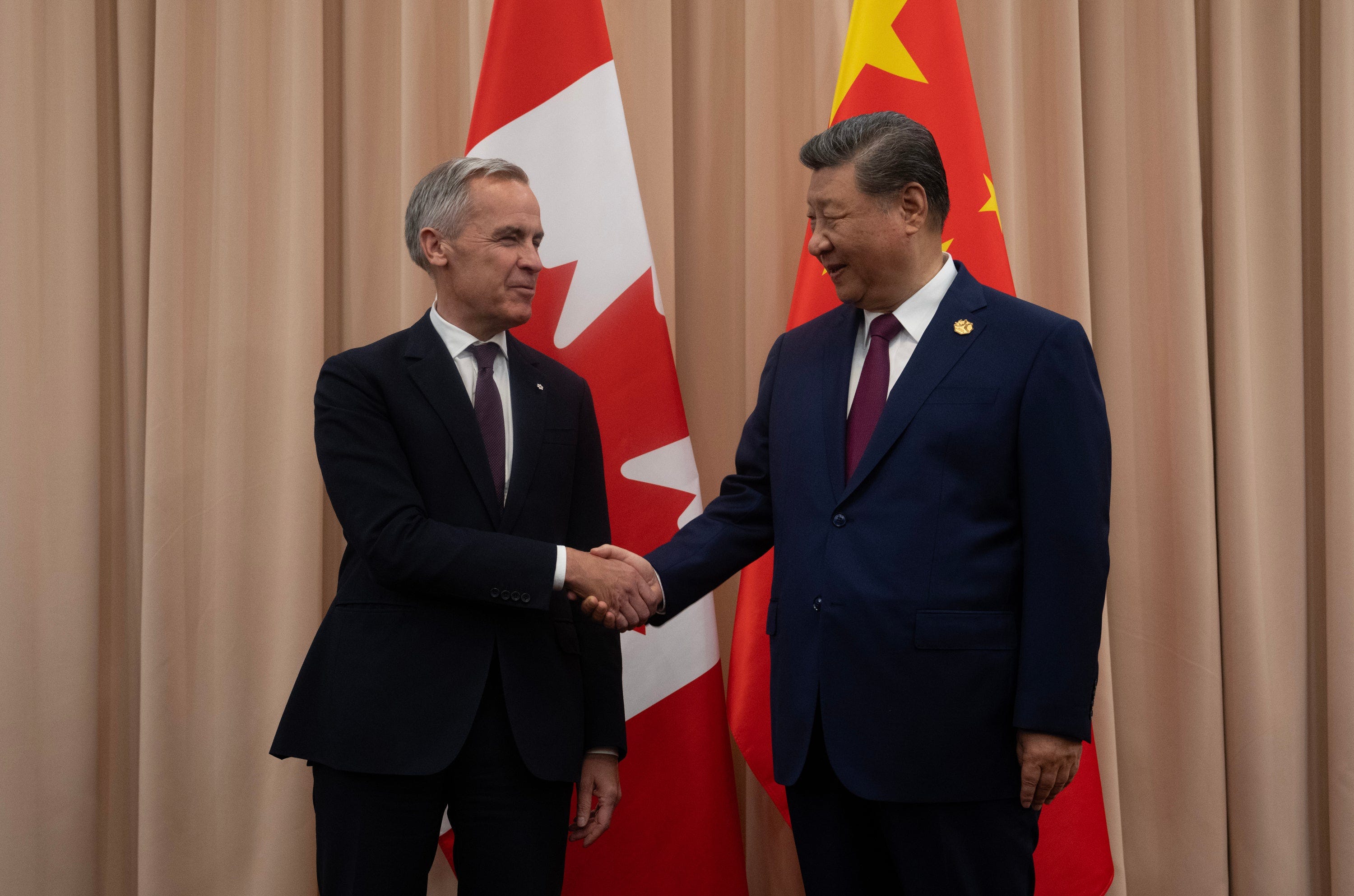
Gord: I think Poilievre would have had a very hard time, obviously, because the Laurentians are not going to go away quietly. But Poilievre has a better sense of Canadian energy security and independence and developing things in Alberta. Carney has done this pivot to China and pivot to the EU, which is bad juju for everybody. That’s not going to work. Why pivot away from your nearest neighbor? Yeah, Trump’s loud, whatever, the tariff problem needs to be resolved. But Canada and the United States have hundreds of years of history, good neighbors, a lengthy and prosperous trade relationship, shared security concerns. Why pivot to China? Like this Mark Carney, we’re going to go be buddies with the CCP.
Another thing the Canadian media have tried to bury or downplay, that many Americans don’t know, is that the Chinese Communist Party has been rightly found to have interfered in a bunch of Canadian elections. In 2019, 2021, they interfered in the election of 20 different MPs. The Canadian version of the CIA, CSIS, has found evidence they’ve been interfering in Canadian politics since the Mulroney years in the 1980s. The Chinese Communist Party is up in Canada’s shit in an incredible way.
There’s a journalist named Sam Cooper who runs the Substack called The Bureau. He’s probably Canada’s best investigative journalist. He’s found the Chinese Communist Party is laundering money via triads, they’re involved in the production of fentanyl in Canada and importing precursors, working with Mexican cartels, laundering money through the real estate market, which is what’s helping inflate all these home values and making it very difficult for young Canadians to buy homes. All of this is because of China. And Mark Carney is like, well, we want more of that rather than trying to work a little better with the Trump administration and increase our relationship with the United States. I think that is folly and doomed to failure.
Natalya: Why is it doomed to failure? It sounds like they’re well on their way.
Gord: It’s more failure for Canada, which has already got more problems than it can shake a stick at. The pivot to China is just bad news. Not going to be good for anybody.
Natalya: Do people really understand? This is so complex. China’s got its hand in everything. We have Confucius Centers at schools that we’ve tried to shut down. The whole gender ideology craze, I believe, is really imported from China. It’s just how they divide people. They convince children not to have any more children. They make sure of it by performing horrific medical procedures. They’re involved in the medical world, in everything. And Trump is really kind of a threat to them, because this is somebody who is putting America first, and they’re trying to impose their will on us, on the world.
Gord: Yeah. I don’t think being friendly with the Chinese Communist Party is a good idea. They’re guilty of many things. The gender stuff is insane. Just having children is so politicized now.
The Canadian government is unwilling to point at the actual guilty parties, which is the Laurentian elite, who don’t care about Canadians anymore.
Natalya: And meanwhile you’ve got MAID.
Gord: Oh, that too. Oh my god.
Natalya: Yeah, MAID. What does it stand for?
Gord: Medical Assistance in Dying.
Natalya: Oh my god. All the slippery slopes the people sounding the alarm bells warned about became true.
Gord: If your listeners want to find out more about MAID and its discontents, there’s a young lady in Canada named Amanda Achtman who runs an organization called Dying To Meet You. It’s about honoring and making better the lives of senior citizens instead of just offing them. She would be a great guest for your show.
Natalya: Yes, I would love that.
Gord: People are in unresolvable pain and torture, you’ve got some terminal medical condition, I get it, there are edge cases. But the problem with MAID is that it’s now one of the leading causes of death in the country.
Natalya: One of the leading causes of death?
Gord: Yeah, I think it’s number four or number five.
Natalya: One last question. The truckers, both in the United States and Canada, would you say they skew more conservative, or are they kind of all over the place?
Gord: At one time, the problem we’re having now is that the industry has been going through so much transformation in the last few years, and it’s downstream of all the things we’ve talked about and more. COVID, mass migration, government mismanagement of everything. I hate using this word because it triggers some people, but from the evidence I can see, there’s an active replacement campaign going on. Displacement, replacement.
Right now, according to records that are unreliable and don’t capture everything, 20% of the truckers in America are very recent migrants, immigrants, asylum seekers, refugees, or illegals. Anecdotally, and from the numbers involved in the corruption of the issue of commercial driver’s licenses, I think that number is actually more like 30, 35%.
One of the reasons that’s happening is economic. This is before COVID, before mass migration, before all the current actors making it worse. The trucking industry’s representative associations, the corporate lobby groups, were always complaining and saying there’s a shortage of truck drivers. That has never been true. What they’re doing is misconstruing a retention problem. The job is hard. You’re away from your family a long time. In many parts of the industry it doesn’t pay that well. You’re exempted from being paid overtime. You’re paid by the mile. The government treats you like a criminal. It’s a hard job, and it takes a certain person to do it. So a lot of people quit.
Instead of trying to figure out how to make the job better or pay better, before all the migration stuff started, the corporate lobbyists in the United States turned to the government to pay for training, subsidizing the training of truckers, making the standards to get a license lower in order to affect this churn model. That churn model has become so important to the industry that they don’t want high-quality truck drivers. They want the bottom of the barrel, cheapest possible thing. That has produced all of these results and run into all of these other problems. Again, COVID, mass migration, total mismanagement of the industry by the government. That’s why I ended up writing this book, End of the Road: Inside the War on Truckers.
Natalya: It’s a manufactured crisis, in other words.
Gord: It’s a distributed and manufactured crisis that would not have taken place if we had allowed typical market economics to work. Just logic and reason: you want high-skill, high-quality, competent truck drivers, treat them properly, pay them well, they’ll stick around. We don’t have all these other problems. But no, the narrowing margins on traffic by corporations like Amazon and every Fortune 500 company in America involved in the material economy. No, no, no, we don’t want to pay too much for trucking. So we have to have lower-quality drivers by any means necessary. Pass the buck to the taxpayer. We have increased truck accidents, collisions, fatalities. That’s a price they’re willing to pay, but they’re not paying it. Everybody else is.
Natalya: I know we’re almost out of time, but as you were talking, it was reminding me of what the unions have done in this country. The teaching funnel, how they’ve lowered the standards, and then you get all these teachers being pushed into schools from the ed schools where they’re indoctrinated, and they’re lowering the standards for kids. They’re lowering the standards for teachers. And they say, oh, there’s not enough teachers, we have to get more. Same with nursing. The nursing crisis, the nursing shortage. The nurses are also represented by the American Federation of Teachers in some states, definitely in New York. So they manufacture these crises and then they fundraise, and it becomes this funnel, this money-laundering scheme where they hire less qualified people and say we have to import them from God knows where. It’s the same playbook across the industries and across our countries. The United States, Canada, and I guess beyond. It’s astonishing. I hadn’t really considered trucking in that way. I appreciate it.
This has been an amazing conversation. I could talk to you for hours. I have so many more questions, but we’ve run out of time, and I’m going to let you go and enjoy your time with your family. We’ll feature an excerpt from the book, End of the Road: Inside the War on Truckers, which is out now. I appreciate your voice and your time.
Gord: Thanks for having me, Natalya. I’d love to come back and expand on this more sometime. I hope your listeners enjoy the book. Take no crap from the media or the government. Take no crap from the liars. Aim higher, aim better. Let’s have competency and skill and craft be honored. The people who are more worried about money and margins and value scraping, we need to move past those folks.
Natalya: Definitely. Thank you so much.


