



My kids are going to live and work in a world built on AI. Yours too.
That is not a prediction, it is already true.
The question is not whether our children will use these tools but whether they will understand them, question them, and stay in charge of their own thinking while they do. Pretending we can wall AI off from childhood and somehow protect them by doing so gets the threat backwards.
The kids who lose are not the ones who learn AI early with good guidance. They are the ones who meet it for the first time at eighteen with no idea how it works, no instinct for when it is lying to them, and no practice using their own brain alongside it.
AI is not going away. It is getting more powerful every month. Pretending we can ban it or hide our kids from it puts them at a serious disadvantage in the world they will actually inherit.
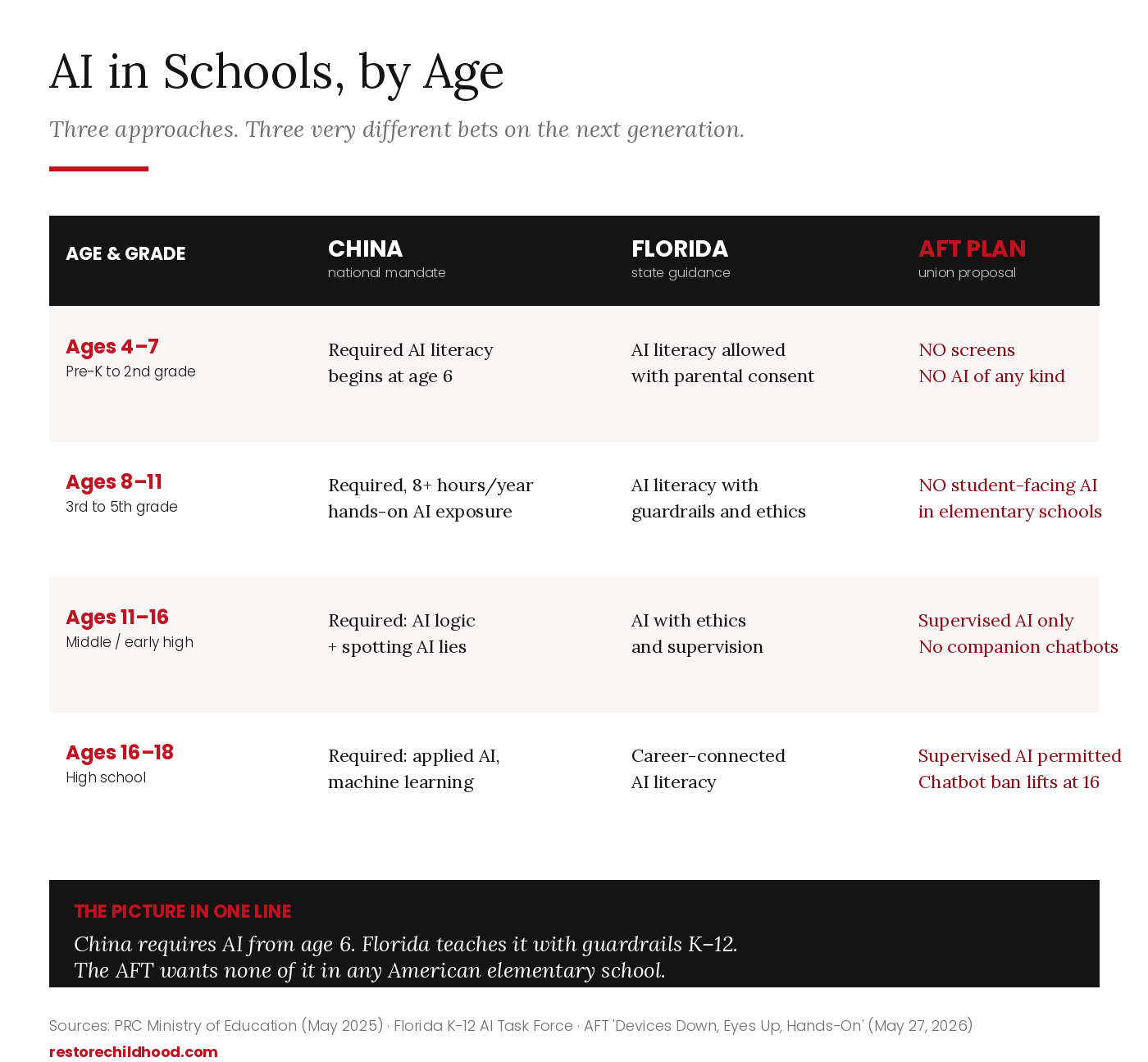
Countries that face that reality are showing us better ways.
China has made AI part of the standard curriculum starting young, with at least eight hours of instruction a year for every student and full integration planned by 2030. Read the policy.
Singapore is using its EdTech Masterplan 2030 to put students first, with responsible AI use, real teacher training, and guardrails so kids learn deeply without losing their own thinking. More on the AI in Education plan.
Estonia launched AI Leap 2025, giving more than 20,000 high school students and their teachers direct access to top tools plus serious training in how to use them to solve real problems— Program site.
Japan, Finland, and Florida are adding strong ethics rules, critical thinking instruction, and clear permission requirements. Use AI only when allowed. Always show your own work. Protect privacy— Florida’s AI task force.
Australia and the UK have gone further and banned social media for kids under 16— Australia’s law. I understand the impulse. Those platforms are engineered to be addictive and they are doing real damage. But this is a decision parents should be making, not the state. Once we accept that the government gets to decide what our children can and cannot access, we have handed away the very authority we are trying to protect. We have spent the last six years watching what happens when officials decide they know better than parents what is good for our kids.
I am not eager to give them another category.
What Australia has done with AI in schools is a different story, and worth paying attention to. Its National Framework for Generative AI in Schools, endorsed by every state and territory education minister and reviewed annually, treats AI as a tool to be taught responsibly rather than a threat to be banned. The framework is built on six principles, including teaching and learning, transparency, fairness, accountability, and student privacy. New South Wales went a step further and built its own student AI tutor called NSWEduChat, which by design refuses to give direct answers and instead asks guiding questions that push kids to think for themselves. By mid-2025, 78 percent of Australian secondary schools were already using AI in some form, with teacher training, privacy rules, and critical thinking built into the model from the start. That is the part worth borrowing.
Now Look at Who is Leading the AI Ban Movement Here
On May 27, AFT President Randi Weingarten stood at the National Press Club and announced a ten-point plan called “Devices Down, Eyes Up, Hands On.” It calls for a ban on student-facing AI in elementary schools, a ban on screens in pre-K through second grade, and a ban on companion chatbots for anyone under 16. Less than a week later, on June 1, NYSUT passed its own resolution echoing the same demands for New York students.
Pause and notice the timeline.
Last summer the AFT signed a partnership with OpenAI and Microsoft to train teachers on AI. Less than a year later the same union president is demanding bans on students using it. The union is not opposed to AI. It is opposed to anyone but its members controlling how AI enters the classroom. Weingarten herself said AI will be an issue in “virtually every contract negotiation” this year.

This is the same union leadership that fought to keep schools closed in 2020 and 2021 while children fell two grade levels behind and lost the most basic social skills. The same leadership that called parents who wanted their kids back in class extremists. Now they want to be the ones who decide what tools our children can and cannot touch in the very classrooms they kept locked.
I am not opposed to limits on screens for young kids. We wrote about classroom screen harms a while back at Restore Childhood, here, and the research on Chromebooks replacing books and pencils is damning. Phones do not belong in classrooms. Companion chatbots designed to simulate friendship for a lonely ten-year-old are a different category of harm and should be restricted.

But banning AI literacy for elementary kids is not the same conversation. That is a choice that hands the next generation to whoever does teach their children to use these tools well, and right now that is Beijing, Singapore, Tallinn, and a handful of American states with the nerve to act independently of union demands.
Risk of Falling Behind
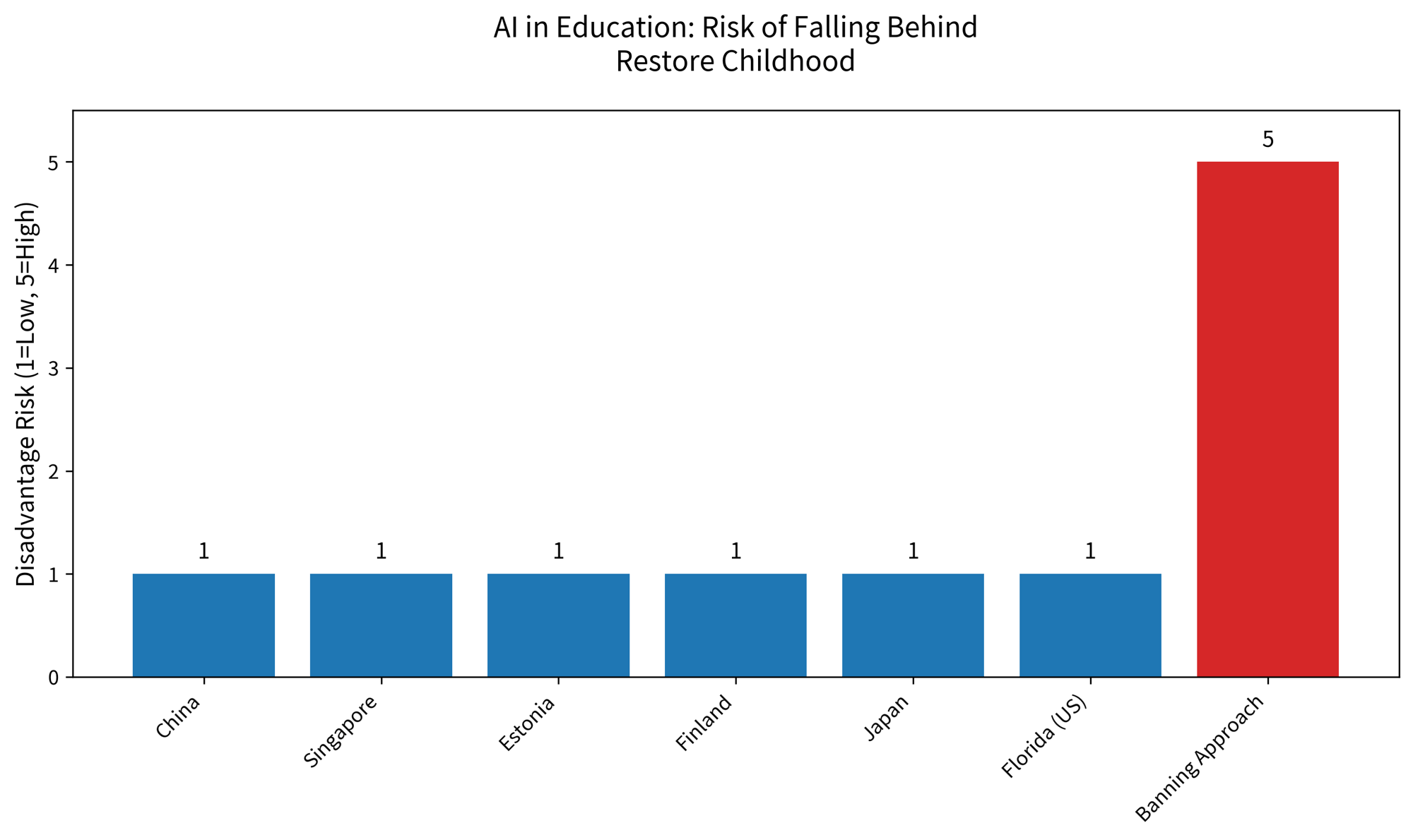
Banning AI puts American kids in that tall red bar. Kids in countries moving forward are learning to triangulate. They check the AI’s answer against their own brain, against books, against a teacher, against the real world. They are gaining a real edge while we argue.
The evidence backs careful integration. Recent studies show AI tools used with proper guardrails can lift math, writing, and problem-solving scores by 15 to 35 percent through personalization and faster feedback. See the review.
The key word is guardrails. Humans stay in charge. Kids still build the muscle.
What a Sensible Policy Actually Looks Like
This is not a partisan question. We can pull the best from every model without adopting any one country’s politics.
Teach real AI literacy to kids, teachers, and parents, so everyone understands the power and the risks. Privacy leaks. Bias. Intellectual laziness. Dependency.
Use clear guardrails like Florida does. Red light for high-stakes tests and unattributed work. Green light for brainstorming, practice, and exploration.
Keep humans first. Kids have to be able to explain their own thinking in their own words, on paper, with a pen.
Run parent workshops so families can guide use at home and protect their children’s data.
Update the rules as evidence comes in. Stay practical, not ideological.

Our children deserve full, joyful childhoods. They also deserve the skills to compete in the world they will graduate into. We can give them both. We cannot give them either by handing the decision to the same institutions that closed their schools and then refused to apologize.
Parents, push your schools for the balanced path.
Ask for parent information nights on AI. Read the union resolutions in your state and ask hard questions about who they actually serve. Talk to your principal. Talk to each other.
We are stronger together. Always have been.
Restore Childhood is a 501(c)(3) nonprofit dedicated to protecting children’s education, health, and parental rights. If you enjoyed this post, please share it and consider supporting our work by upgrading to a Paid Subscription.
I applaud this fantastic post! Indeed, Weingarten is not removing AI from the educational system; she wants teachers to keep the knowledge for themselves, trickling it out to students in the form of lessons. The AFT's upcoming collaboration for AI teacher training is disturbing for a number of reasons, one of which is: Why should the nation's children be the beta test group for this program?
When I began teaching, we were experts in our fields who were brought in to teach. There was no training per se. Now, the training concept has overtaken subject knowledge on the part of teachers. For example, I know several engineers who wanted to take a sabbatical and give back by teaching in high schools. When they undertook the mandatory "training," they reported that the methods of teaching were considered more important than whether teacher candidates actually knew the subject matter.
This reminds me of Khan Academy in public schools. It became extremely unpopular with many teachers solely because many students rapidly surpassed the teacher's level of knowledge. They clamored for controls to keep children from proceeding too quickly. So, of course, the AFT wants to keep children from fact-checking lessons, researching independently, and looking up sources.
Love your discussion of AI literacy and critical thinking regarding its use. We already have that problem with Google, where people believe the results on the first page even when they should know better.
I am against laptops for children because their form factor makes good posture nearly impossible. Computer setups in schools need to be ergonomically correct, which requires good chairs, desks at variable heights, and large monitors. The random garbage that children are forced to use on these laptops is so bad that it is difficult to believe anyone considered the long-term consequences.
Thanks for finding the overseas information! The links are very useful. I have been meaning to write a post about first steps to introducing AI to lower elementary children. By the way, did you know that Chinese children learn classical poetry in Kindergarten? I bought a few books last trip for my own language study.
Just teach it like we would each any other technology. Yet the AFT getting kickbacks from certain AI providers threatens to derail this very reasonable approach...because money.