


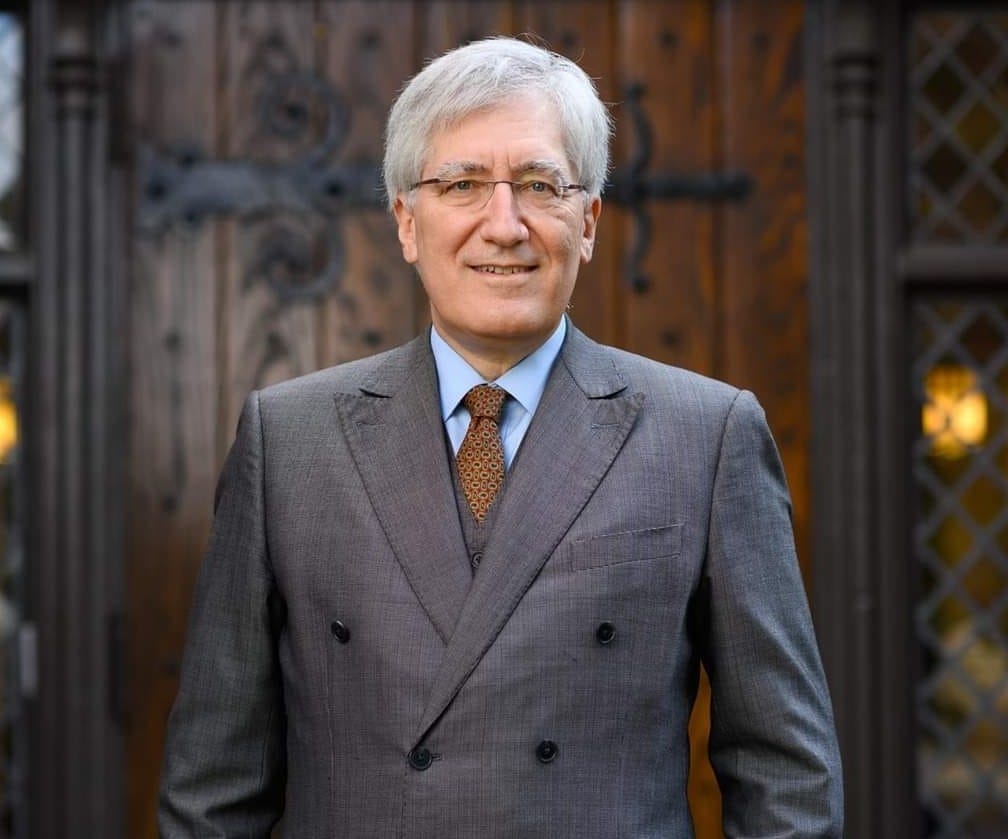
On Thursday I went to hear Robert P. George speak at the Manhattan Institute.
George is the McCormick Professor of Jurisprudence at Princeton, where he has taught for forty-one years. He is a co-author of the Manhattan Declaration and one of the most important conservative intellectuals in America, not because he is loud, but because he is serious. His 2025 book, Seeking Truth and Speaking Truth: Law and Morality in Our Cultural Moment (Encounter Books), is organized around a diagnosis of the age we’re living in and a prescription for how to get out of it.

Here’s what I took from it.
George was interviewed masterfully by the inimitable Reihan Salam, president of the Manhattan Institute, who asked thoughtful questions and allowed George ample time to respond and explain. It was a rare thing: a real conversation between serious people, unhurried and unafraid of complexity.
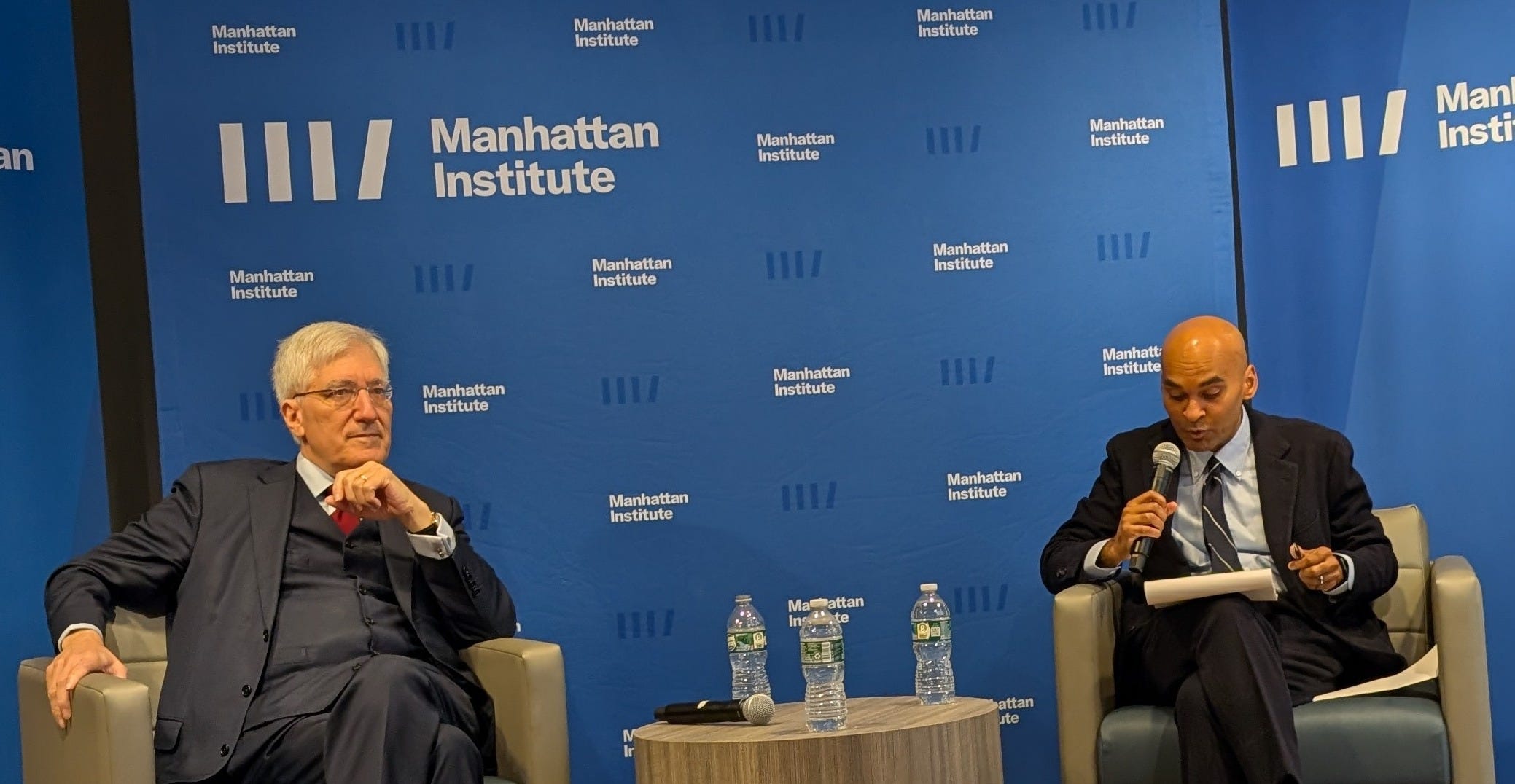
George began with a framework that every parent and teacher needs to hear. Historians label the great epochs: the medieval period was the age of faith, where the touchstone of truth was conformity to religious teaching. Then came the Enlightenment, the age of reason, where the touchstone shifted to the findings of rational inquiry and science.
So what age do we live in now?
“To my very great regret, I have to conclude that we live in the age of feelings.”
What do people today, especially young people, treat as the touchstone of truth?
Not faith. Not reason. Feeling.
What we have now is something entirely different. The new subjectivism is authoritarian.
How I feel about something determines whether it’s true. There is even the belief that you are male or female depending on whether you feel like a male or a female. Objective reality, independent of how we happen to feel about it, is disappearing.
George was careful to distinguish this from the old-fashioned, genteel moral relativism many of us remember from college, the “you have your truth, I have mine” cocktail-party version.
That relativism was at least polite.
What we have now is something entirely different. The new subjectivism is authoritarian. It produces cancel culture, the vilification of anyone who dissents. “This is no longer ‘we don’t know what’s true, so let’s be nice to each other.’ This is ‘we know exactly what’s true, and we’re going to enforce it, rudely, if necessary.’”
That is exactly what so many of us experienced during the pandemic, and what parents experience today when they push back on gender ideology in schools, or question the childhood vaccine schedule, or challenge any institutional orthodoxy. The enforcers aren’t uncertain. They’re 100% certain.
And they will punish you for disagreeing.
George said, we need free speech precisely for the sake of truth-seeking. To fulfill our mission as truth seekers, we need the freedom to explore any line of argument, put any proposition on the table, challenge any point of view.
He argued that once the old morality gets wiped out in the name of “neutrality,” what fills the vacuum is not neutrality at all. It’s a new ideology, just as aggressive and authoritarian as anything it replaced. “It’s no longer ‘the government shouldn’t be in people’s bedrooms.’ Now it’s ‘bake the cake, go to jail for using the wrong pronouns.’”
So why is a man who believes the state is legitimately concerned with the human good also so fanatical about free speech? Because, George said, we need free speech precisely for the sake of truth-seeking. To fulfill our mission as truth seekers, we need the freedom to explore any line of argument, put any proposition on the table, challenge any point of view.
“I don’t want a single view I hold, no matter how deeply cherished, no matter how important I think it is, to be immunized against critique. We all know about our own fallibility. We know we can be wrong. We’re just not sure about the specifics.”
I thought about this in the context of my own work on 15 Days. What I’ve encountered, over and over, is not a lack of evidence about what was done to children during the pandemic but a lack of willingness to revisit prior certainty. George’s framework names this perfectly: we’re living in an age that has replaced the pursuit of truth with the protection of feelings.
Then came the part about students…
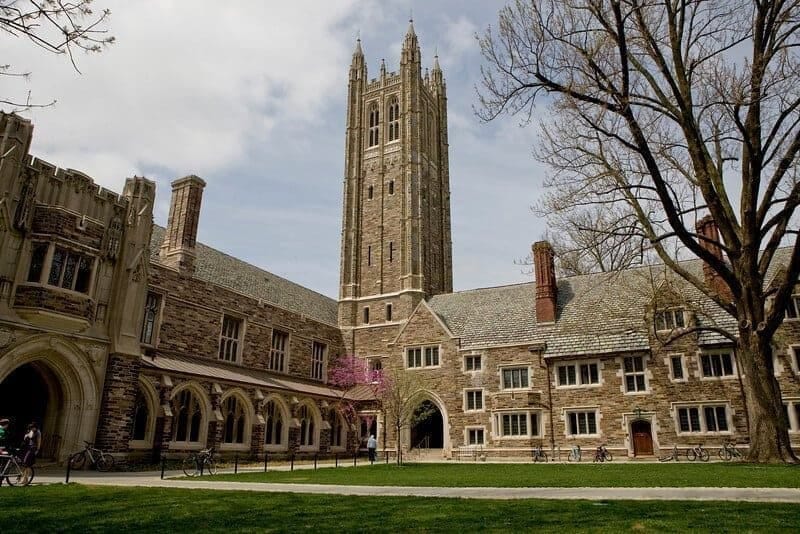
Nassau Hall, Princeton University, where George has taught for forty-one years.
George has been at Princeton for forty-one years. He’s notorious for his one-man war against grade inflation. Last semester he had 140 students and gave no A’s. He hasn’t noticed a decline in intellectual quality or ambition since 1985. But there has been one significant change, and it’s happened in the last decade:
“The shortening of students’ attention spans. I’ve cut the quantity of reading I assign by thirty percent. Not because students refuse to do it, but because they cannot sustain the attention to get through it.”
The timing, he said, lines up perfectly with when kids who grew up on smartphones started entering college. He hasn’t budged on rigor or quality. But on quantity, he had no choice.
On young faculty, George was devastating. The only reason he got hired at Princeton was old-school liberals who genuinely believed in hearing all voices. But they have not replaced themselves. “The two, now going on three, generations of students they produced do not have those old-fashioned liberal values, not even lip service. They’ve got an ideology. You’re expected to get on board.”
There is now, he said, a massive number of woke faculty who sincerely do not understand that what they’re doing is indoctrination. They would pass a lie detector test.
They really think they’re teaching.
“I’d give anything to get those old-school liberals back. They were so much better. But they’re gone, and they didn’t reproduce themselves.”
So should conservatives should counter-indoctrinate?
George said the teacher’s mission is to form young people to be determined truth seekers and courageous truth speakers, and the way you get there is not by giving them a line, even a true line, but by exposing them to the best that has been thought and said on all sides.
“I assign Marcuse. I would be in trouble in Florida with the ‘stop woke’ laws. I teach divisive concepts. I have students read ‘Repressive Tolerance’ because it’s the best essay I know against my view of free speech, and I want them to wrestle with it.”
You can’t form a truth seeker through indoctrination. You can only form one through encounter.
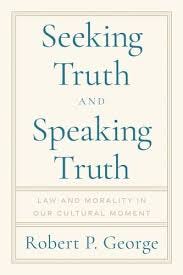
George’s new book, Seeking Truth and Speaking Truth (Encounter Books, 2025).
I walked out of the Manhattan Institute on Thursday thinking about leadership, which was George’s real subject. He said we need it in every domain: intellectual, religious, professional, civic. He pointed out that one person, at one moment, can change everything.
And he named his students, not his books or arguments, as his legacy.
What I’ve learned through over the past six years is that George is right: the question is never whether values will be imposed. The question is which values?
And the answer depends entirely on whether there are people willing to seek the truth and then speak it, out loud, in public, at cost to themselves.
That’s what Robert P. George has done for forty-one years.
It was a privilege to hear him do it on Thursday.
15 DAYS: The Real Story of America’s Pandemic School Closures is now streaming. Watch it now on Amazon Prime Video, Apple TV, or Google/YouTube TV.
Dear Natalya,
It is not surprising that universities lost the trust of the American people when they abandoned their truth-seeking mission under the influence of postmodernists who do not believe that there is objective truth.
Thanks,
randy