


This is the first installment of a four-part investigative series. A new part publishes each week. Read the series introduction here.
On October 2, 2020, with more than 200,000 Americans already dead from COVID-19, actress and activist Jane Fonda joined a Zoom call with progressive organizers to discuss the pandemic. She was laughing when she said it.
“I just think COVID is God’s gift to the left.”
She caught herself. “That’s a terrible thing to say.” Then she kept going: “It has ripped the Band-Aid off who he is and what he stands for. We have a chance to harness that anger and make a difference.”
Nobody in the media made much of it. The schools were already closed.
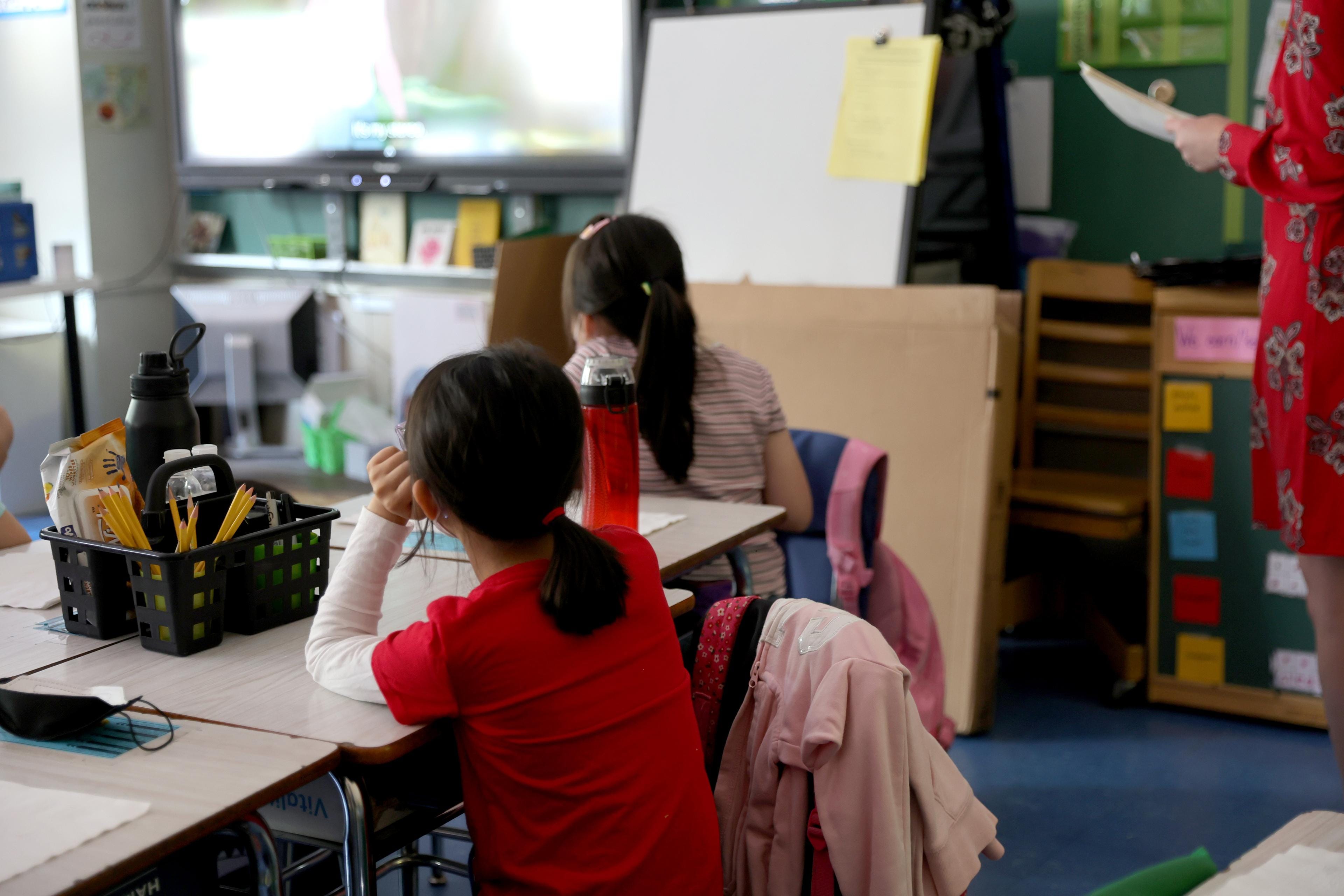
Six years ago, American children disappeared from their classrooms. Not for fifteen days, despite what the government promised. For months. For years. For some of the most vulnerable children in the most union-controlled cities in America, for the better part of two full academic years.
Many never returned.
Before we can ask why the schools closed and stayed closed, and what they reopened to, we have to be clear about what actually happened, because there has been considerable effort in the years since to revise and soften the history.
On March 15, 2020, New York City Mayor Bill de Blasio announced the closure of the city’s public schools. Within days, schools across the country followed. The stated reason was to slow the spread of COVID-19. The stated timeline was approximately two weeks.
Fifteen days to slow the spread. A temporary emergency measure.
Six years ago, American children disappeared from their classrooms. Not for fifteen days, despite what the government promised. For months. For years. For some of the most vulnerable children in the most union-controlled cities in America, for the better part of two full academic years.
The science that would have allowed a more calibrated response was developing faster than most people in authority chose to acknowledge. By April and May of 2020, evidence was accumulating, including data from Sweden which had kept its schools for children under sixteen open throughout the spring, that schools were not significant sites of transmission. Children were not at meaningful risk of serious illness. The risks to teachers, compared to other essential workers who continued to show up throughout the pandemic, were not substantially different. The American Academy of Pediatrics called in late June 2020 for children to be physically present in school in the fall, stating explicitly that the most vulnerable students -- low-income children, children of color, children with disabilities -- relied on schools most heavily for services they could not get anywhere else.
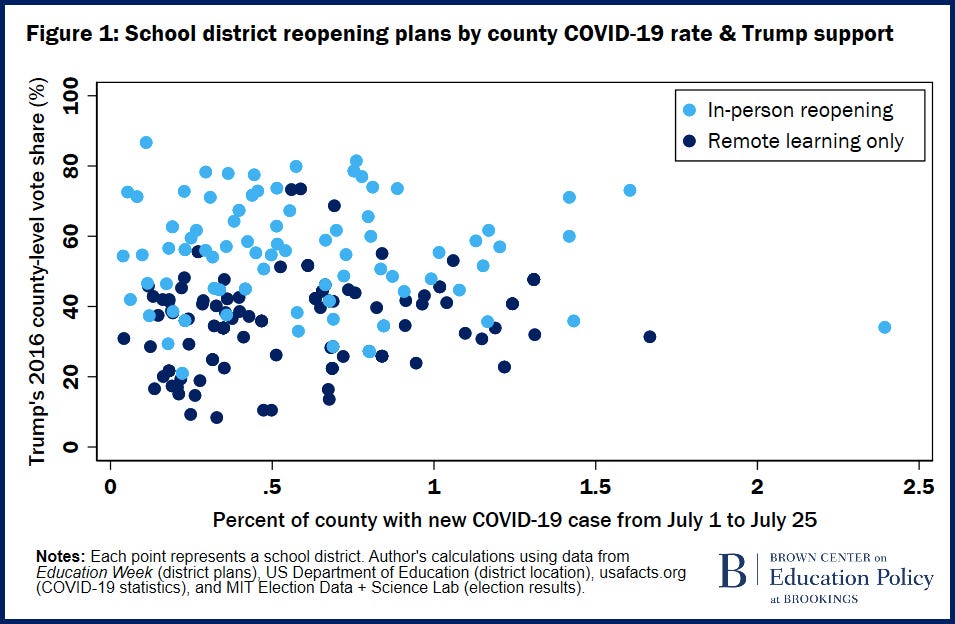
The central documented fact about the American school closures is this: the primary driver of whether a school district stayed open or closed was not the local rate of COVID transmission. It was union density and partisan politics. A working paper released through Brown University’s Annenberg Institute for School Reform in October 2020 by political scientists Michael Hartney and Leslie Finger examined over 10,000 school districts and found that politics drove reopening plans “far more” than public health conditions.
“I have never been more confident in a correlation,” lead researcher Hartney said, “than between the partisanship of a district and what they elect to do here.” Research published in Social Science Quarterly in 2021 by economists Corey DeAngelis and Christos Makridis reached the same conclusion: school closures were uncorrelated with virus incidence but strongly correlated with union membership rates. In states with right-to-work laws, schools were 14 percentage points more likely to reopen in person.
This was not simply union resistance at the local level. At the highest levels of federal public health policy, the American Federation of Teachers was directly shaping the guidance that determined when and whether schools could reopen.
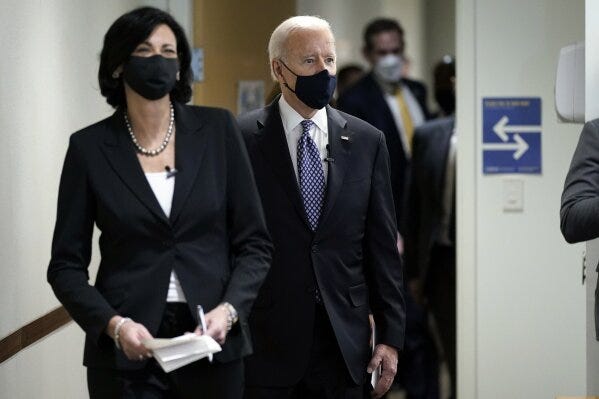
In February 2021, the Biden administration’s newly confirmed CDC Director, Rochelle Walensky, was preparing to release long-awaited guidance on school reopening. The evidence at that point supported reopening. Walensky had said publicly just days earlier: “School should be the last places closed and the first places open.” She had also stated that teacher vaccination was not a prerequisite for schools to reopen.
Research published in Social Science Quarterly in 2021 by economists Corey DeAngelis and Christos Makridis reached the same conclusion: school closures were uncorrelated with virus incidence but strongly correlated with union membership rates. In states with right-to-work laws, schools were 14 percentage points more likely to reopen in person.
What happened next was documented through Freedom of Information requests filed by the watchdog group Americans for Public Trust, which obtained more than 400 pages of emails between the AFT, the CDC, and the White House, first reported by the New York Post on May 1, 2021.
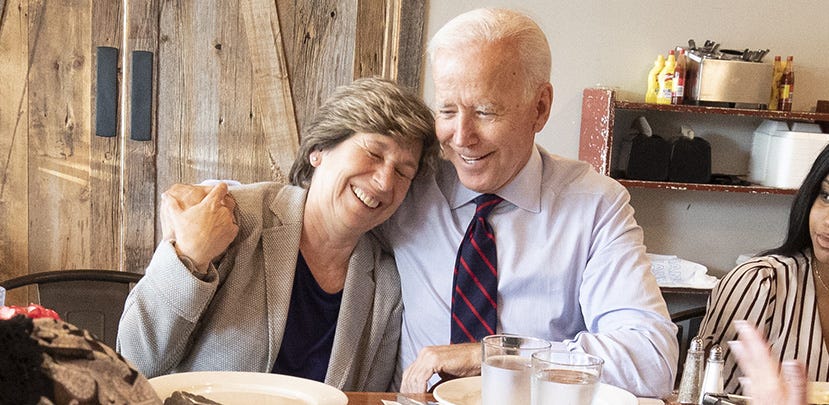
The emails showed that AFT senior director Kelly Trautner wrote to Walensky on February 1, 2021: “Thank you again for Friday’s rich discussion about forthcoming CDC guidance and for your openness to the suggestions made by our president, Randi Weingarten, and the AFT.” Trautner had been given access to a draft of the guidance over the weekend and provided suggested revisions. Walensky replied that the AFT’s suggestions were being incorporated “with just a few small tweaks.”

Two of the AFT’s suggested language changes were adopted nearly verbatim into the final CDC guidance. The most consequential was language suggesting guidance might need updating “in the event high-community transmission results from a new variant of SARS-CoV-2,” a provision that gave unions a perpetual tool for demanding continued closures. The Washington Examiner separately reported that the CDC had originally drafted language saying schools “can” provide in-person instruction, changed after Weingarten’s input to say schools have the mere “option” to. That single word kept millions of children home.
The CDC sent the AFT and NEA an embargoed copy of the final guidance before releasing it to the public. In a subsequent congressional investigation, CDC officials acknowledged the level of coordination with the teachers unions was “uncommon” and that the CDC does not typically share draft guidance outside the agency before publication. Text messages obtained by the Fairfax County Parents Association showed Walensky texting Weingarten warmly after the guidance was released, calling her “Friend” and writing that Weingarten’s public praise of the guidance “gave me the biggest smile of my week.”
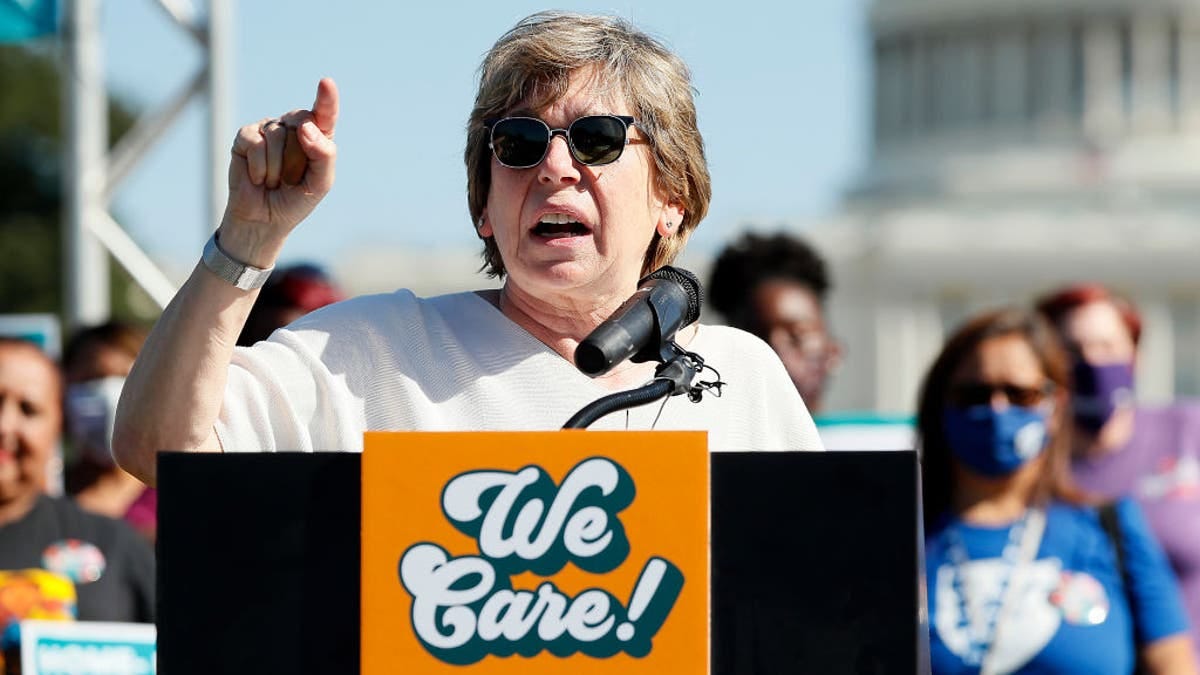
Weingarten appeared before the House Select Subcommittee on the Coronavirus Pandemic in April 2023 to answer for the AFT’s role. She denied the union had exercised undue influence. She had retained a defense attorney before testifying.
Text messages obtained by the Fairfax County Parents Association showed Walensky texting Weingarten warmly after the guidance was released, calling her “Friend” and writing that Weingarten’s public praise of the guidance “gave me the biggest smile of my week.”
None of this happened in a vacuum. The Biden administration came into office after an election in which teachers unions spent over $100 million in political support for Democratic candidates.
The AFT spent $46.9 million on political activities in a single fiscal year. In the 2024 election cycle, 99.9% of AFT’s federal political contributions went to Democrats and the NEA gave 98%. In both cases, contributions to Republicans amounted to rounding errors. An administration that owed its electoral victory in significant part to that financial and organizational support was structurally unable to force the unions to reopen schools against their will.
The guidance was written the way the unions wanted it written. In some of the bluest parts of the country, the schools stayed closed.
The damage from the closures has been measured with a precision that is almost unbearable to read. The National Assessment of Educational Progress documented a historic collapse in American student performance. Reading scores for 13-year-olds fell to levels last seen in 1971 -- fifty years of reading progress, erased. Math scores fell to 1990 levels. For 9-year-olds, the 2022 NAEP recorded the largest average reading score decline since 1990 and, in five decades of testing, the first-ever math score decline in the assessment’s history. Lower-performing students lost the most: students at the 10th percentile dropped 12 points in math compared to 3 points for students at the 90th percentile. A Richmond Fed analysis documented that the losses fell hardest on students from disadvantaged backgrounds. The Harvard-Stanford Education Recovery Scorecard found that the districts with the most severe losses were overwhelmingly the districts where schools stayed closed the longest, which were overwhelmingly the districts with the strongest union presence.
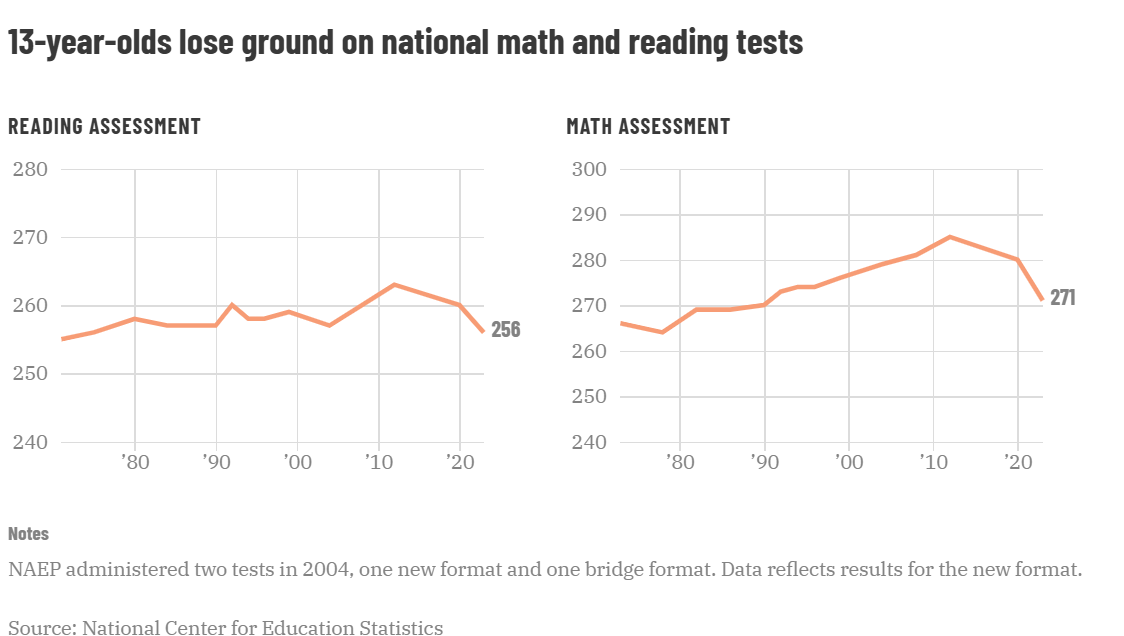
The children who could least afford to lose academic time lost the most. The unions that kept the schools closed claimed to be acting in the interests of the most vulnerable children. The data documents the opposite.
By 2022 and 2023, as the scale of the learning loss became impossible to ignore, a different narrative took shape. The unions and their allies argued that the closures had been necessary given what was known at the time. That the science had been uncertain. That the unions had ultimately supported reopening. Randi Weingarten went on a media tour describing herself as an advocate for school reopening. She was profiled sympathetically in the New York Times by Michelle Goldberg, who wrote that Weingarten had “spent much of her energy, both in public and behind the scenes, trying to get schools open.” She was praised by Secretary of Education Miguel Cardona and First Lady Jill Biden.
Her union issued a statement saying it had “always” supported reopening.
The FOIA emails, the congressional testimony, and the text messages between Walensky and Weingarten tell a different story. The science was not as uncertain as claimed. European schools had demonstrated reopening was safe. The CDC had drafted language stating schools “can” provide in-person instruction before Weingarten’s input changed it to say schools have the “option” to. As the Washington Examiner documented, that single word, from “can” to “option,” likely kept millions of additional children out of school.
The union that spent the pandemic keeping American children out of school was, by 2022, spending its members’ dues to fund an ideological infrastructure whose effects on American education go far beyond anything the school closures themselves produced. That infrastructure is what this series is about.
The four parts of “The Closed Classroom” are free to every subscriber. Restore Childhood is a 501(c)(3) nonprofit. We do not take advertising. We do not take money from the organizations or industries we cover. If this work matters to you, the best thing you can do is share it. The second best is to upgrade to a paid subscription and ensure the next investigation gets built. There is also something coming in the weeks ahead that paid subscribers will get first access to, connected to the work we have been building for three years. It will be worth being here for.
Become a paid subscriber here. Cancel any time.
The harder question is not what happened, or how. It is why, and for whom.
When you study the school closures in full, when you look at who made the decisions and who suffered the consequences, you find a consistent pattern. The children who lost the most were the children with the least political power. The institutions that kept the schools closed were the ones with the most. The administration that allowed it was the one those institutions had helped elect. And the curriculum that the children found when they finally came back to school was not the curriculum that had been there when they left.
Whose interests were actually served when the schools closed?
Not the children’s. Not the teachers’. Not the parents’.

That is the question this series will answer over the next three weeks. The answer connects the school closures to a documented socialist organizing strategy inside the unions, to a curriculum infrastructure actively teaching American children that their country is not worth defending, and to a formal partnership between the American Federation of Teachers and the World Economic Forum -- an organization that holds its summer meetings in China and whose founder described his goal, in his own recorded words at Harvard in 2017, as penetrating the cabinets of governments worldwide.
No conspiracy is alleged. What is documented is a convergence: a set of overlapping political, ideological, and geopolitical interests whose outcomes for American children align with the interests of people who do not wish this country well.
Beijing did not close the American schools. But the people who did close them, and the people who shaped what those schools taught when they reopened, built something that serves Beijing’s interests without Beijing needing to spend a dollar.
That is the story. Part Two publishes next week.
Watch 15 DAYS on Amazon Prime | Apple TV | Google Play | Host a screening | All links
This article brings back so many memories. My youngest was a junior in high school when they closed for “two weeks” to “flatten the curve “. Pretty much the rest of the year was ridiculous because there was nothing in place for “online learning “ so they were doing the best they could with not much. She has dyslexia. So being told “read this, we will review in our zoom call on Thursday” when she normally learns much by the day to day discussions in class, was devastating to her learning. Fortunately, they went back in person in the fall of 2020. With none of the hybrid classes that were half from home and half at school. The principal asked my husband and I to help with a reasonable mask policy, so we reviewed the data, which by FALL OF 2020 showed kids before puberty didn’t spread Covid well, teens were more likely to spread it. So elementary kids didn’t mask (they weren’t going to wear them properly anyway, as anyone who has been around kids and is realistic would admit) and middle and high school students were supposed to mask. (Our daughter told us half of them didn’t wear them right either, which wasn’t a surprise). They didn’t even require them in the spring of 21, and our state stopped masking by April of 21. That summer was the worst ever for every other pediatric illness, except Covid, because none of those went away with masking, kids were just delayed in exposure, and got multiple infections back to back, or at an unusual age, because instead of getting their immunity boosted when little brother got hand-foot-mouth disease, they hadn’t been exposed to the virus in over a year, and immunity waned. I can’t even imagine how bad it would have been for our daughter had the schools been closed her entire senior year. They had a homecoming dance. They had sports, they had prom. And no one got sick. And despite what the media and unions claim, there was evidence schools could and should be open, and that children were not big spreaders of Covid. The damn AAP was advocating for opening schools in the fall of 2020, until Pres. Trump said schools should open and then they flipped their position and said online was fine. I completed a pediatric residency, and where we were taught that screen time (granted they meant TV, because none of the other stuff was around) should be limited, as it wasn’t good for kids. Then to have these reported experts claim it was fine - it was ridiculous. I had the mom of a kindergartner tell me in the spring that she thought it would be better for her child if she read to him every day, worked with him on his alphabet, and then let him play in the backyard. I agreed with her. So much of what was done was not done for the children but for the selfish (or fearful, or evil) adults who knew better, and I’m inclined, at least for the union leaders to go with the latter, because they then went out and lied, claiming that they were behind reopening schools. Fortunately our schools, even public, were back to full in person learning by the spring of 21, but that still was enough time to profoundly affect children and teens. Anxiety and depression were skyrocketing, not sure that has improved even five years later. But I will never forget what the Randi Weingartens of this world did to kids. She should never be allowed to have a say in education again.