


Decisions are being made inside your child’s school right now about what they read, who they speak with privately during the school day, and which artificial intelligence sits between them and their homework, and parents are no longer being asked to sign off. Two stories from the past year explain how that happened.
The first story is the launch of the National Academy for AI Instruction by the American Federation of Teachers on July 8, 2025. Microsoft put in $12.5 million as the lead partner, OpenAI added $10 million, and Anthropic contributed $500,000 in the first year. The academy occupies a state-of-the-art Manhattan facility under AFT leadership and aims to train 400,000 K-12 teachers over five years, roughly one in ten public school teachers in the country. AFT president Randi Weingarten continues to promote the project at panels hosted by Microsoft and other technology partners in Washington.
The teachers who use these tools in your child’s classroom are trained by the union, working from a curriculum shaped jointly with the platforms.
What could go wrong?

The teachers’ union is now the gatekeeper of AI in tens of millions of American classrooms, with Microsoft, OpenAI, and Anthropic writing the checks.
The second is well-covered in Kelly Ske’s Washington Examiner story “How Community Schools became a Planned Parenthood pipeline” which traces the community schools model back to Joy Dryfoos, recruited decades ago by what is today the Guttmacher Institute, Planned Parenthood’s policy arm.
Dryfoos went on to chair what is now Advocates for Youth, one of the country’s most aggressive promoters of confidential medical services for minors and the removal of parental consent requirements. She helped found the Coalition for Community Schools, the organization that today coordinates the conversion of ordinary public schools into year-round wraparound service hubs offering counseling, sex education, and on-site medical care, often with parents kept outside the room. Watch this PragerU short video version of Kelly’s reporting to understand more.

Inside a ‘community school,’ children meet medical staff, counselors, and sex educators with no parent in the room.
That same Coalition is now housed at the Institute for Educational Leadership in Washington, and its policy research arm is the Learning Policy Institute, whose published funder list includes the Bill and Melinda Gates Foundation, the Ballmer Group founded by former Microsoft chief executive Steve Ballmer, the Chan Zuckerberg Initiative, the Ford Foundation, and the Carnegie Corporation of New York. Learning Policy Institute reports map out the federal grant streams that pay for the model, including a 2023 paper identifying roughly $366 billion in available federal funding that community schools can tap.
The NEA Foundation runs a Southern Regional Partnership for Community Schools and signed the Coalition’s letter to Congress demanding that community schools become an allowable use of COVID-19 relief money and that the federal investment climb from $30 million in fiscal year 2021 to $1 billion by fiscal year 2025.
The federal money came.
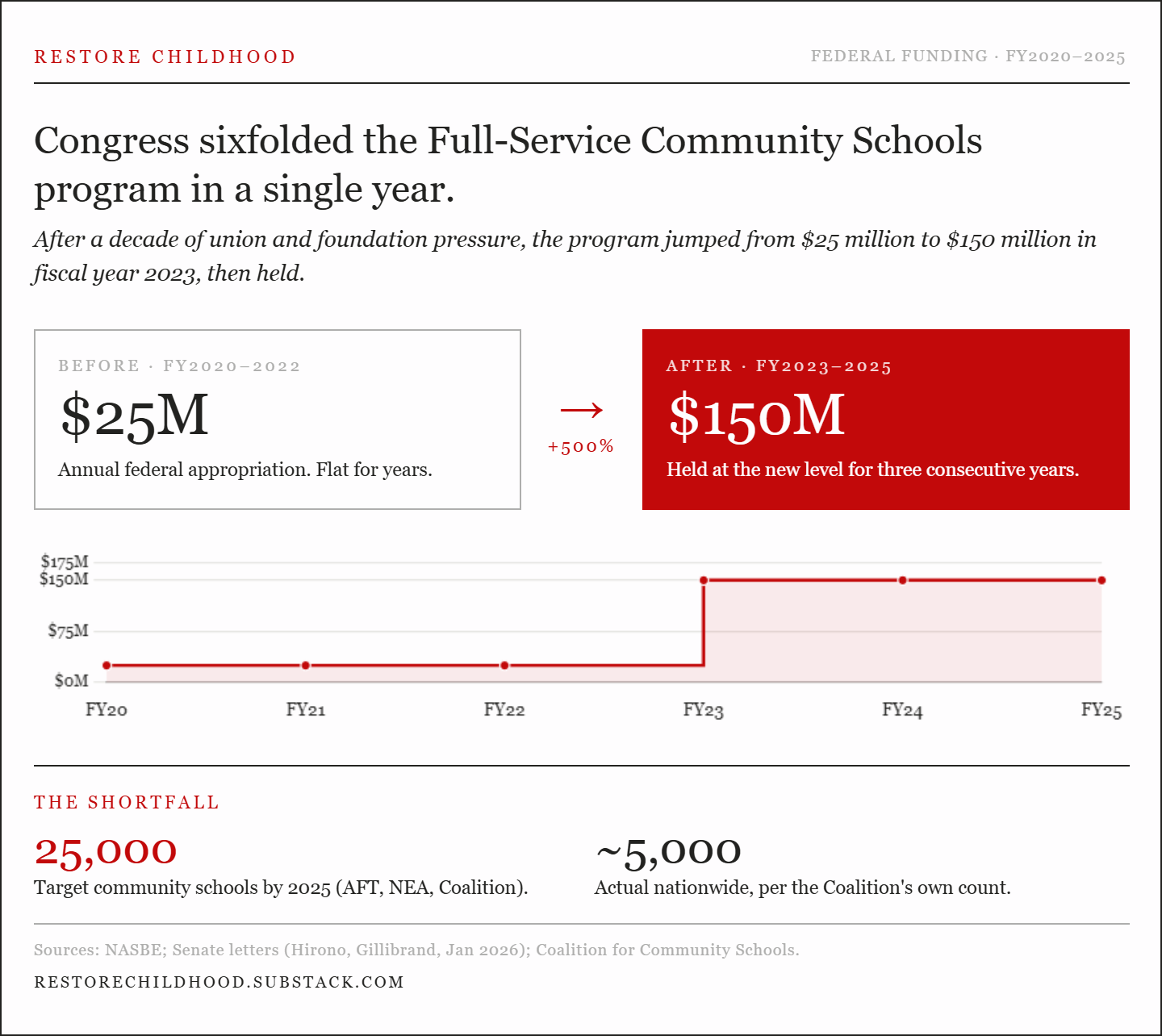
The Full-Service Community Schools program grew fivefold, from $25 million in fiscal year 2020 to $150 million in fiscal year 2024, with the AFT crediting the Biden administration for a $125 million increase between 2020 and 2023. California alone allocated $4.1 billion in 2021 through the California Community Schools Partnership Program, the largest state-level community schools initiative in the country, now reaching roughly one in four California public schools.
In May of 2026, Senators Chris Van Hollen, Kirsten Gillibrand, Ben Ray Luján, and Representative Susie Lee reintroduced the Full-Service Community Schools Expansion Act, endorsed by the Coalition for Community Schools, the AFT, the NEA, and the Institute for Educational Leadership, to push the federal commitment higher still.
The American Federation of Teachers' community schools page, last updated in May 2024, lists close to 900 community schools inside the AFT family of affiliates, names a target of 2,500 within three years, and reiterates the union's commitment to the Coalition's push for 25,000 community schools by 2025. That deadline came and went more than a year ago. The Coalition for Community Schools puts the current nationwide total at roughly 5,000 community schools, one fifth of what the unions and their funders set out to build, and as of this post neither the AFT page nor the Coalition page has been updated to acknowledge the miss.
The federal money climbed all the same. Congress raised the Full-Service Community Schools program from $25 million to $150 million in 2023 and held it there through fiscal year 2025, and the Department of Education's December 2025 move to claw back $168 million in already-awarded grants brought every senator in the union coalition into the open to defend the program. The AFT runs intensive workshops to expand the model in places like Rome, New York, and steers its members toward the federal grants that remain.

Restore Childhood warned about this dynamic in July of 2023, when the federal Department of Education proposed removing the requirement that parents give consent before a school accesses their child’s Medicaid benefits to pay for special education services. That post explained that the rule change only made sense inside the larger push for community schools, where the school steps in as the primary contact for a child’s health, financial benefits, and care. The post named the leaders driving the model. Becky Pringle at the NEA has said publicly that she wants every school in America to become a community school, and Randi Weingarten at the AFT has positioned her union as the loudest national booster of the wraparound model since before the pandemic.
The community schools model and the AI-in-classrooms model run on the same logic. Each one widens the school’s authority over the child’s whole life. Each one shrinks the parent’s role to permission slips and email blasts. The clinic does it with confidential health services. The algorithm does it with confidential data. The law that used to ask the parent first now informs the parent later.
The history curriculum running through that same pipeline operates on similar logic. The Zinn Education Project, built around Howard Zinn’s A People’s History of the United States, now reaches roughly one in four U.S. history classrooms according to the American Historical Association’s 2024 survey of more than three thousand teachers. Zinn, who died in 2010, described himself as something of an anarchist and something of a socialist, and the NEA formally committed in 2021 to partner with the Zinn Education Project to push that curriculum into classrooms across the country. Our Closed Classroom series lays out the documentation in four parts, including How a Dead Marxist Became the Most Powerful Force in American Education and Democratic Socialists of America Told Members to Become Teachers.

The community schools model and the AI-in-classrooms model run on the same logic. Each one widens the school’s authority over the child’s whole life. Each one shrinks the parent’s role to permission slips and email blasts. The clinic does it with confidential health services. The algorithm does it with confidential data. The law that used to ask the parent first now informs the parent later.
There are practical steps any parent can take right now, without waiting for the next election cycle.
Find out whether your district has formally joined the community schools network. A quick search of your district name alongside "Coalition for Community Schools" will usually surface the answer, and the Coalition itself maintains a directory of its state and local network affiliates you can cross-check. The U.S. Department of Education also publishes the Full-Service Community Schools program page, which lists every district that has received a federal community schools grant and is the cleanest paper trail. If your district appears on either list, request in writing from the superintendent's office the partnership agreements, the full list of on-site providers, and the current parental consent forms, and file a public records request if the district stalls.
Ask your school for the name and data policy of every AI tool your child uses during the school day, including whether the tool came through the AFT National Academy for AI Instruction. Under the federal Family Educational Rights and Privacy Act, parents have the right to review the education records a school keeps on their child, and the U.S. Department of Education's Student Privacy Policy Office publishes specific guidance on FERPA, virtual learning, and third-party ed-tech vendors and accepts complaints from parents whose schools refuse to comply. This information is rarely volunteered, and most parents have not yet thought to ask for it. The third step is forwarding Kelly Schenkoske's piece in the Washington Examiner and the Closed Classroom series to one parent in your school who still believes none of this applies to their family, because the documentation is what makes the conversation possible.
Restore Childhood is a 501(c)(3) nonprofit that takes no advertising and no money from the industries or institutions we cover. The NEA and the AFT have together moved $254 million in member dues to outside political and ideological organizations since 2015, and that money funds the campaigns, the curriculum partnerships, and the political infrastructure described in this post. Restore Childhood is funded by readers, and a paid subscription is the most direct way to keep this reporting going.
For paid subscribers, something new is coming this summer. We are releasing the full 15 DAYS documentary on America’s pandemic school closures here on Substack, available only to paid subscribers. If you have been waiting to upgrade, this is the moment.
Everything that has happened inside American schools since 2020 points to one conclusion: the institutions that were supposed to protect your child are now the institutions that require the most parental scrutiny, and the only person reliably positioned to do that scrutinizing is the parent who refuses to be moved out of the room.
Had a chat this year with a faculty member of Ohlone Community College in California while trying to find the bookstore and library. She works with teachers (not students) on curriculum and teaching methods. All course textbooks must now be online from just one provider’s portal and “free.” The “college” doesn’t now have a campus bookstore, just logo clothes at a gym store by the sports facilities. They still have a campus library with a dwindling number of books for the TL,DR students who want ever more library space for their AI computers to “help” do all their course work while they can “attend” all classes by zoom or post-class streaming. That faculty lady was so very proud about 50% and an “increasing number” of the students who never set foot on the campus. “With the best of intentions”… “what could possibly go wrong?”
As a union delegate for CTA, which is affiliated with NEA, not AFT, I see a lot of information here that is true, wrapped with information that is not exactly true. Within CTA, we are actually fighting the onslaught of AI in education. We have statewide committees looking at how to make sure that our union contracts have language to support human teachers and in person learning, and that AI is not put in front of students - for all the many reasons we can think of. In my Silicon Valley district there are always edutech teachers who try out all the new tools, praise their supposed benefits for teaching and learning, and it’s no different with AI. In my school district, I have been trained on how to use Magic School and Rainna chatbot to create vocabulary lists and example sentences in six different languages and rewrite Spanish texts using particular vocabulary lists, along with generating lesson ideas, reading comprehension questions, etc. In using AI tools, I have to go through everything meticulously and judiciously, and I’m not convinced that we should be trading our water supply and land for the data centers necessary for this “tool”. However, the tide has swung fast in the opposite direction regarding all digital technology during the past school year, to the degree that finally my colleagues are ditching computers altogether and having kids do everything with paper and pencil again (as a high school Spanish and ESL teacher I never bought into the overuse of technology and I saw the writing on the wall with Google Translate years ago).
I also live in San Francisco and share a building with an Anthropic developer. While Bill Gates and education venture capitalists and entrepreneurs tout all the great “things” with AI, and maybe even AFT, most on the ground veteran teachers are not impressed. We now have definitive evidence that screens are bad for kids’ brains, and many of us are thrilled to have research backing us in the fight against AI and digital educational platforms. My point here being that it is not the teachers unions that are bringing AI to your child, it is the administrators, school boards with special interests, and edtech / AI companies themselves that are the force that we must reason with as parents and teachers together. I recommend writing letters, inquiring about all the educational platforms being used and how much time your kid will spend off the computer during the school day. Gather some articles, and go to the school boards. Parents have far more power in this area than we do as teachers. Also note that kids are much more passive in front of computers, which translates to compliant and easier to manage. It’s no secret that the most stressful aspect of the teaching profession is classroom management and student behavior. Teachers that cling to computers have easier classrooms to manage and likely less learning. Demand paper textbooks, binders, and writing instruments, and fully immersive in person learning!
As far as the Community Schools model is concerned, I understand the issues around medical consent and privacy, which is deeply troubling in California, as the age of consent is only 12, the kids hardly know what their bodies are for at that point, and certainly can’t advocate for themselves adequately. But a dark passage to wrest control of the kids from their parents is not the reason that poor schools want and need wrap around school services. Community Schools are happening only in poorer districts in particular schools where students and families need more social services, healthcare, homework centers, food pantries, and possibly laundry. It’s a way to bring in local people- the parents, teachers, and staff members to create a vision and a plan for what the particular school needs- it’s a push for more local control and for more family governance, not less. This collaborative governance structure is written into the model itself. I think that there are a lot of misconceptions about why so many of us want such a model of schools- while I don’t doubt there are outside influences pushing for them, there is also a great need in poor communities to have more easily accessible services. As a teacher, I have had to use my own time and resources to get kids glasses, for example, or find out where a family might park their mobile home without getting ticketed. Because many of our students in the USA are quite poor, do go hungry, and have limited access to healthcare, we teachers in public schools feel that we should not be the ones taking care of the problems that society lays at our door. Yet, by law, we have to educate all. And we can’t teach hungry kids who can’t see, have health problems, or have housing issues. While I wish that we had a more robust support structure for poor families as they seem to have in many European countries, we don’t in the U.S., and the Community Schools model is an attempt to remedy some of these stressors on schools. But the model demands local governance- they must be run in partnership and collaboration with the families, teachers, and staff. I have several colleagues across California that work in such schools. They paint a very different picture than what is portrayed in this article, and I think it’s worth looking into why so many of us want more services within our schools.