


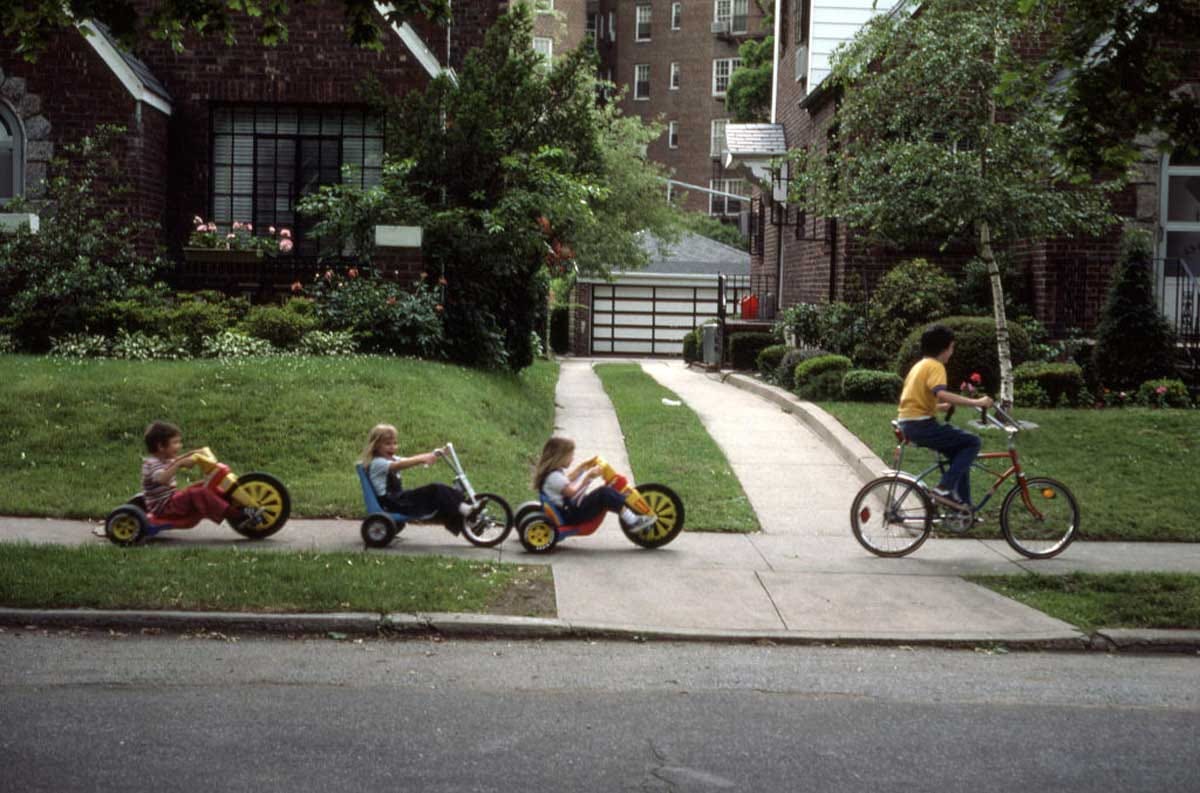
I just read this piece by my dear friend Leslie Bienen and had to share it because, as usual, Leslie makes way too much sense.
Living in New York, I'm constantly surrounded by the exhausting theater of optimization—parents scheduling their toddlers like tiny CEOs, families racing from one "enriching experience" to the next, everyone desperately trying to make everything grander, faster, more. The competitive energy is palpable, and frankly, it's making us all a little crazy.
Leslie's essay hit me like a cool breeze on a sweltering subway platform. Her rejection of the whole "maximize everything" culture feels radical and necessary, especially for those of us watching our kids grow up in this pressure cooker of a city. The reminder that we don't need to turn every single experience into a "journey" that transforms us? Pure gold.
As someone who's sometimes guilty of getting caught up in the frenzy, I needed to hear this: slow down, appreciate the people around you, love your kids exactly as they are in whatever stage they're in right now.
The journey really is the destination—not some optimized, Instagram-worthy version of it.
So here's my challenge to all of us: put your phone down, look up and around, and actually enjoy this fleeting summer and beautiful, long, sunny days. Trust me, your kids will remember the moments you were present way more than they'll remember whether you maximized their potential.
—Natalya
PS: These Lifesavers commercials, really evoke the sweetness of summer and savoring each moment with our children.
A great deal of attention has been focused recently on why Americans are unhappier than residents of comparatively wealthy peer nations. A variety of reasons have been floated by pundits, politicians, sociologists, internet gurus, and just about anyone with an email address.
We eat alone too often.
Even when we do eat together, we gobble our food, and meals are not long enough to derive social benefit. (This is actually my own pet theory; I just returned from France and a meal there is at least a two-hour affair, an at-times frustrating reality for us American gobblers. Once at a restaurant in Italy one of my family members asked for the check inappropriately early and the daggers coming out of the waiter’s eyes were terrifying).
We move around too much. We don’t live in intergenerational families. We are too competitive. Too greedy. Too online. We use too many medications. We are too fat to exercise. We commute too many minutes. Our cities are hellscapes and our rural areas hollowed out by drugs and unemployment. We have too few children and too many first dates.
It all starts to sound like the Berenstein Bears book, Old Hat, New Hat: The protagonist bear tries on a series of hats that are sequentially “too big, too small, too flat, too tall, too loose, too tight, too heavy, too light. Too fancy, too shiny, too frilly, too silly.” You get the idea.
There is also the camp that says that the Happiness Index is a terrible instrument and is based on self-report surveys that are unreliable and poorly framed; Yascha Mounk did a piece on the flaws of the Happiness Index in Persuasion that was… persuasive. So, maybe we aren’t the unhappiest rich country?

However, even if we agree that the World Happiness Report is a sham, and I do believe this, it is hard to dismiss the curdled-milk feeling that seems to tug, like a destructive undertow, at American life these days. The fact that we keep electing Donald Trump as president—and whether you voted for him, hate him, or do not care about him at all, it is undeniable that he has run two campaigns heavily predicated on the idea that the current iteration of the USA sucks—is proof positive that, as my mother says, “the country is in an ugly mood”.
Why?
By most measures we live longer, have bigger houses, more stuff, have more outlets to communicate, and more of us are better educated than at any other time in human history. Hans Rosling, the Swedish public health professor extraordinaire, wrote a whole book called Factfulness about this misunderstanding of where we are in the advancement timeline, in which he reminded us to embrace what he termed the “secret silent miracle of human progress”. He had a variety of explanations for why our cognitive biases lean toward thinking everything is getting worse, including that the media themselves often are misinformed about how well-off humans are compared to our past incarnations.
Rosling did a series of clever experiments he conducted at media conferences showing that, when asked questions such as “How long do most women in the world go to school?” or “How has the percent of people living in extreme poverty changed in the past twenty years?” “Has the number of people dying in natural disasters gone up or down?” representatives from media outlets performed worse at answering them correctly than a group of chimps selecting answers at random.
Watch the whole Ted Talk - it is brilliant.
I agree with Rosling’s view that a more accurate perspective on human conditions in the past hundred years would help ameliorate some of what he saw as a global negativity bias but I also believe there is a specific aspect of American life that is contributing to our cultural unhappiness in a way that is, well, uniquely American. I am referring to our relentless drive to maximize. The idea that if experiences are not somehow maximized they are—and should be-- unsatisfying seems like a recipe for everyone to be unhappy with everything and everyone in their lives at all times.
The ubiquity of the word ‘journey’ is a good example of this phenomenon. Using the term ‘journey’ to describe experiences places the unbearable weight of the need to maximize on them because ‘journey’ is freighted by the idea that experiences have to take you somewhere new and exciting, that they should leave you forever changed. This subtext is not just unrealistic, it sets up the idea that if your experiences do not constantly reinvent you and lead to Johnny or Jane 2.0 they, and by extension you and everyone else who participated in them, has failed somehow.
I suspect the idea of maximizing was born in advertising and foisted on the rest of us because, after all, maximizing requires new products, so very many new products, but it is probably also just a trap set for us by human nature because when your basic needs, i.e., food and shelter, are taken care of what else is left but to compete with your fellow villagers over who is having the ‘best life’? I loathe the expression ‘living your best life’. We don’t need to live our best lives and being told we should constantly be living some form of a ‘best life’ makes everyone feel like a failure.

Here are a few examples that pop up on my Facebook feed, or elsewhere: Breastmilk jewelry. There are a staggering number of companies selling jewelry filled with breastmilk, surrounded with ad copy about memorializing one’s “breastfeeding journey”. These items are not cheap, either. Is it mean-spirited that I find this weird and a bit gross?
But also, does breastfeeding have to be a journey?
I don’t think breastfeeding my children—while I am sure it accomplished many good things and I enjoyed it—left me forever changed, except that my breasts might be droopier than otherwise (though I am also better protected from breast cancer). Still, I reject the framing of maximizing breastfeeding into a journey.
You can also go on a ‘gender journeys mentorship program’ (Google returns hundreds if not thousands of links for the search term ‘gender journey’) and don’t get me started about websites selling experiences, trainings, and paraphernalia related to parenting journeys. There are also addiction journeys, divorce journeys, psychedelic journeys, polyamory journeys, and the list goes on and on. There are also services to help “maximize your child’s athletic potential”, your time, output, writing, money, sex appeal, and a book that skipped the specifics and went straight to “Maximizing You”.
To all of this, I say No; I do not wish to maximize or be maximized by anyone or anything.
Ok, if there is a site promoting “your child’s journey to loading the dishwasher correctly” I am all in, but that’s it!
Otherwise, I refuse to embark on any personal ‘journeys’, I am not trying to ‘live my best life’, to squeeze the most out of everything I buy, I do not care if my children reached the peak of their athletic ability, I don’t need constant reminders of breastfeeding or of pets that have died (I remember both just fine), to have a spreadsheet of people I am having relations with so I can keep them all straight, or to pay someone else to figure out what gender I am. I’m in Popeye’s camp: I yam what I yam, and that’s all that I am.
Join me- you might just be way happier.
Thank you for this concept about the "maximizing" craziness.
I read this today, just after getting off of a paratransit bus, during which the driver and I had been talking about meals we like to make, en route home from my weekly, over-priced grocery trip.
Lately I keep overshooting my weekly food stamp allotment.
As we discussed food prices, the driver, who i had forgotten somehow annoyingly finds time to can her own food and bake bread to save money after working her full-time job, was talking about her elaborate--what I'll call--"food perfectionism journey."
I, on the other hand, have excruciating foot pain, and recently have been searching for reasonably healthy and affordable home-cooked recipes that can get me off my feet in 5 minutes.
Plus who the heck has time or inclination in 2025 to make and can pasta sauce or bake bread to save a few bucks?
That's from my young, over-ambitious, perfectionist hippy-foodie days.
When my feet didn't hurt.
Besides, I can throw together a diced onion, browned ground beef, and a can of pureed tomatoes pretty quickly once a week to last several days, so why would I home-can it--hours on my feet to make extra? Although even cooking it fresh each week is pushing it on time and foot pain. I'm 63.
But what really got me was when she said she has always believed in only buying foods whose ingredients she can pronounce. (Yawn. Cliche.)
I said I used to do that but had gone overboard and gotten neurotic with it.
Her eyes expressed recognition.
I'd told her previously I'm recovering from an eating disorder (ED), caused by dieting.
Or what I'll call my "eating disorder journey."
The food perfectionism and dietary obsessions are everywhere these days!
And it's making us sicker, it turns out.
And not only with rapidly increasing rates of EDs.
In ED recovery, we learn that one of the most common effects of dieting is breakfast-skipping, which I've done for years as part of my "dieting journey."
In the ED recovery world, it's called "morning anorexia" and its taken v-e-r-y seriously.
Eating restriction of any kind is taken seriously in that world, because it usually causes rebound eating or even binge eating, usually at night, when the hunger has grown too much after a long, hard day of dieting. And rebound or binge eating is usually on less-healthy foods than if one had just eaten an extra bagel and cream cheese at breakfast or extra sandwich when hungry for it at lunch.
I just read yesterday that a whopping 25% of Americans are now skipping breakfast.
1 in 4!
And that ample studies have shown that breakfast-skipping is strongly associated with greater likelihood of developing diabetes and heart disease. (Due to all the ensuing bingeing, and grabbing foods higher on the food chain, to fill an overly hungry stomach on the run.)
So, we have doctors and public health officials telling us to lose weight--by dieting, taking appetite suppressants, and exercise-dieting (which also causes bingeing) to prevent diabetes and heart disease, but the dieting (food restriction) causes diabetes and heart disease!
Yet again, two friends just told me their doctors have put them on restrictive diets or appetite suppressants "for health" without first asking one of them if she ate breakfast daily, or determining how the other one was restricting her food intake, first.
The first thing any doctor should ask of anyone of greater size, or of any size with dietary diseases such as high blood pressure or elevated blood sugar is, "Do you eat breakfast daily? If so, before 8 am?"
The #1 known thing we can do to prevent diabetes and heart disease is to eat breakfast 7 days a week, specifically before 8 am daily, the research on tens of thousands of people and multiple studies show.
Even skipping breakfast once a week increases the risk of these diseases.
It helps to eat a full, *heart healthy* breakfast, such as a couple of bowls of whole grain cereal with soymilk or other plant milk, with fruit, and something such as peanut butter toast (or canned baked beans on toast). But any breakfast is key.
In our medical and public health instructions to "maximize" via weight loss, and the dieting, "healthy eating" obsession, and food perfectionism that has ensued (Weight Watchers, Nutri-System, Noom, Slim Fast, organic, paleo, keto, low-carb, high-starch/low fat, local, vegan, farm-to-table, etc.), we have lost sight of the basics (taught in ED recovery) which is to first NORMALIZE eating: eat breakfast, in the early morning, as part of 3 meals per day, plus 1 - 3 snacks as needed to tide oneself over until the next meal.
And to fill up at each meal or snack.
Eating 3 meals, plus snacks, per day, at consistent times, is the starting point and foundation of ED recovery.
The goal of which, for plus-size ED clients, isn't to lose weight, but to restore NORMAL, non-dieting, non-restrictive eating.
That means, first and foremost, to fill up on 3 meals a day, especially breakfast.
And we're taught in ED recovery, it doesnt matter if the food is "perfect." Just, on a consistent meal schedule, 3x/day, sling all or most of the food groups (whole starches protein, heart-healthy fat, fruit and vegetables, and dairy or non-dairy alternatives, and tasty extras, including dessert, on the table and let everyone assemble their own breakfasts or sandwiches and enjoy foods that are tasty, such as ranch dressing to go with the carrot sticks, so that everyone wants to eat.
So I was happy and proud today to reach an "eating disorder recovery journey" milestone, to impulsively buy some cheap Jiffy blueberry muffin mix, to quickly and easily make muffins to have for an easy breakfast item tomorrow, which happens to have ingredients I can't pronounce.
Which I then felt affirmed in doing, by your article rejecting "maximizing," and instead embracing returning to NORMAL: which in my case is simply eating breakfast before 8 am. (Which I haven't done in years.)
The perfect is indeed the enemy of the good.
I'm going to tell the bus driver about my muffin-eating with ingredients I can't pronounce next time I see her.
Has anyone else here had it with food and eating "maximizing" and perfectionism?
Thank you!