


“We can’t continue to let an entire generation of children be unwitting participants in an AI experiment. It is time to get back to the basics and restore childhood and learning in ways that allow children to flourish and develop as humans should; learning in real life with real people, not in an artificial tech induced one.”
As we move through August, many parents are preparing to send their kids back to school. With summer winding down, the focus shifts to purchasing new school supplies, clothes, shoes and figuring out bus routes. This year, the impact of how AI will be used in schools is also weighing on a lot of parents' minds.
Results from a recent survey conducted by the S2D Foundation of 1,500 parents found that 91% did not want their children using AI in school. However, the US Department of Education released a statement on the Guidance on Artificial Intelligence Use in Schools looking to leverage federal funding to do just the opposite of what the overwhelming majority of parents want.
According to the U.S. Secretary of Education, Linda McMahon, “Artificial intelligence has the potential to revolutionize education and support improved outcomes for learners”. Let’s not forget that this woman repeatedly referred to AI as A1 (Steak Sauce) during the ASU+GSV Summit back in April.
I am pretty sure parents would much rather that A1 Steak Sauce be offered to their kids at school instead.
AI is a new and powerful tool that is rapidly changing, therefore no long term research is available on the negative effects it could have on healthy brain development. It was only 15 years ago when the first iPad was released and now alarmingly 40% of 2 year olds reportedly have their own tablet. Fortunately, organizations such as GAINING, are compiling research and warning about the dangers of this relatively new type of screen time and how it negatively impacts brain development in babies and toddlers. We owe it to our children to learn from the not-so-distant past and stop the tech industry from further disrupting what’s needed for healthy brain development.
I shudder to imagine the irreparable damage that will occur if we wait until 2040 before realizing that placing a powerful tool such as AI in the hands of children was a mistake.
For adults, there is a growing body of research demonstrating the negative effects that using AI can pose such as cognitive offloading and declining critical thinking skills. Even more concerning are the harms that Stanford researchers are warning against with the dangers that AI chatbots can have on children and adolescents.
To be sure, AI tools could play an important role when used by adults to support completing tasks that do not require a human element such as creating class schedules, writing lesson plans, organizing calendars and such. However, we tread very dangerous waters when powerful generative AI tools are placed in the hands of students. Rather than teaching students to “use AI”, wouldn’t it be better if they were just taught “about AI”.
Just last month, the American Federation of Teachers (AFT), the second-largest U.S. teachers’ union, along with OpenAI, Microsoft and Anthropic, announced that it was creating an A.I. training center for educators, the National Academy for AI Instruction. The academy will be located in Manhattan, with the goal that educators will be trained so that “artificial intelligence is taught and integrated into classrooms across the United States.”
Not surprisingly, the 3 leading chatbot makers (OpenAI, Microsoft and Anthropic) are generously providing the $23 million in funding for this AI training center for teachers. In a recent NY Times article about this joint venture, OpenAI’s chief global affairs officer, Chris Lehane, stated he believes that schools should teach “Reading and writing and arithmetic and learning how to use A.I.”. His company, OpenAI, accorrding to their website believes “Generally speaking, we think more usage of AI in the world will lead to good, and want to promote it.”
Microsoft and OpenAI have also signed the Pledge to America’s Youth:Investing in AI Education. These companies, and all the others that have signed the pledge, will profit significantly from the adoption of AI tools in education for students and teachers. This is happening despite what the overwhelming majority of parents want and before we fully understand the true impact it will have on children’s brain development.
Curious about the financial incentive to push AI in schools, I asked Open AI’s ChatGPT about the projected market growth and this was its response…

So according to ChatGPT, the market will reach over $25 billion in less than 5 years. I also asked Google the same question in their search function and got this response…
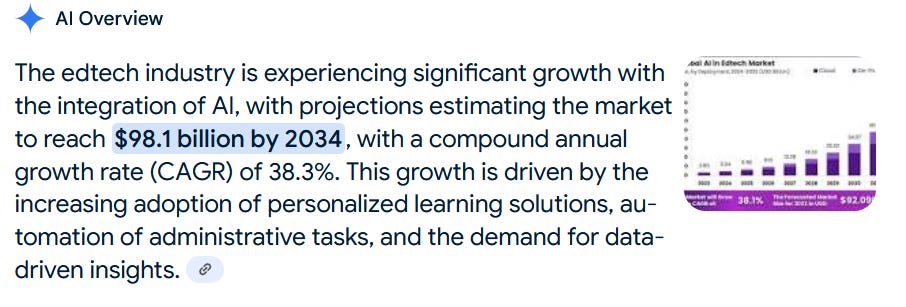
A $98 billion dollar industry is a staggering number and a difficult one for concerned parents to push back against. To borrow from Dr. Richard Freed, author of Better Than Real Life, would we allow McDonald’s or Coca-Cola to be in charge of creating the dietary guidelines for kids and in schools no less? While that would seem ludicrous to allow the fast food industry to set dietary guidelines, we also shouldn’t allow the tech industry to set guidelines and push their tech products into schools for kids to use.
The article Big Tech Hubris And Greed Behind Digital Education Failure highlights the money trail between the tech industry and its infiltration into education in the guise of "edtech” since the early 2010’s. While The Educational Technology Timeline provides a detailed timeline of how our education system transitioned into the tech heavy classrooms seen today with even our youngest learners.
In 2012, there was never any solid data to support the potential that swapping out traditional tools and methods, such as textbooks for chromebooks, would actually improve learning and our test scores show the results.
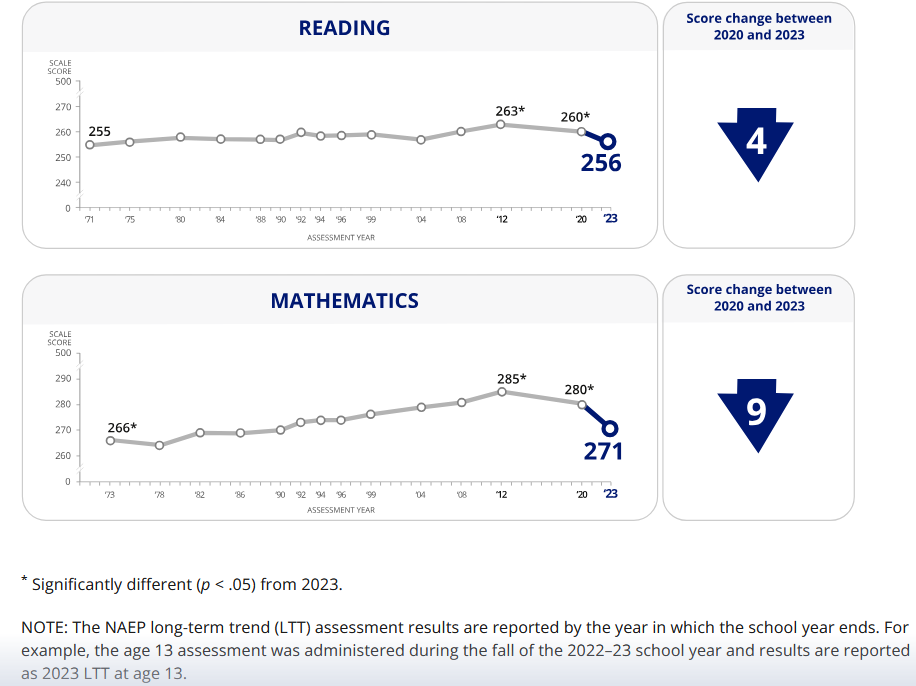
While there seems to be a wanton disregard for the perils of edtech over the last 15 years, the solution that the tech industry and education leaders continue to push for declining reading and math scores is ironically, more technology and in the form of AI.
I find it ironic that the American Federation of Teachers who represent 1.8 million members, many in the education field, is partnering with companies that are actively designing tools as a way to phase out the need for actual teachers. This is not conspiracy, this is being said out loud and this time we need to listen.
There are many examples of these conversations such as Michael Horn and Diane Tavenner on the podcast, Class Disrupted. During their conversation about online math programs, they describe how children could spend up to 1, 2 or maybe 3 hours a day on the “personalized” programs while also boasting that supporting the students “doesn’t have to be done by a math teacher and a math expert”.
Sal Khan, developer of Khanmigo, a generative AI learning program, feels the same. In a recent 60 Minutes interview, when asked about this concern that teachers may have, Khan replied that he was “pretty confident that teaching-- any job that has a very human-centric element of it is-- as long as it adapts reasonably well in this AI world, they're going to be some of the safest jobs out there.” So as long as ‘us teachers’ adapt reasonably well to this AI world, we should be fine. I don’t find his confidence or his response reassuring.
There are also schools like the Alpha School, which puts children as young as kindergarten (only 5 years old) on their own device using AI programs to complete reading and math lessons with an adult (not a teacher) nearby only for support and encouragement. Rather than needing actual teachers, they view the adults' role in learning for “coaching and mentoring”, not teaching. According to the NY Times, this type of AI driven education is coming to a school near you!
There is so much that is lost when you remove human connection from teaching and learning. Dr. Jared Cooney Horvarth, who has written about the failures of edtech, describes one of the most important components needed to learn, empathy. A critical factor needed for empathy is two brains interacting, which he describes in this video Teachers vs AI, Do Teachers Still Matter?.
Yes, teachers really do still matter. The fact is, we are humans and human-to-human interaction plays a vital role in healthy child development and is critical for learning. It simply can not be replaced by something that is “artificial”.
During childhood, it is a societal obligation to provide children with experiences that nurture and foster their brain and cognitive development, not hinder. Frustratingly, tech and education leaders seem to ignore this responsibility. Parents and educators need to collectively reject the empty tech promises about AI’s potential and protect our children from receiving a subpar education that occurs when technology replaces a human.
Take a look at these photos of classrooms from the U.S. Department of Education / Flickr account taken on February 6, 2009…

This is what classrooms should look like; filled with books, pencils, papers, glue and scissors. These classrooms were not saturated with digital screens of unvetted edtech products and unsafe internet access. This is what classrooms looked like when children were performing much higher in reading and math and before their mental health significantly declined.
Now look at what classrooms look like in 2025, where desks are now occupied by a computer screen with unfettered access to the internet….
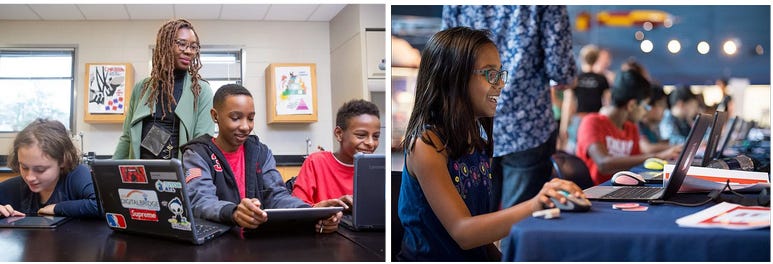
Image source: Department of Education, X
As a society, we cannot let the tech industry dictate what happens in the classroom using AI under the illusion that it “has the potential to revolutionize education” as Linda McMahon believes, an empty spokesperson for a product she clearly doesn’t understand.
Even chatbot creator and Facebook founder, Mark Zuckerberg, doesn’t want this for his own kids. He was recently busted for creating a secret school for his own children and an elite few others, modeled after his own upbringing; in schools that were tech free, with low student to teacher ratios.
I think we all know what the driving force behind AI’s potential to improve education is… $$$. Sadly, our supposed leaders do not seem willing to hit pause and take the time needed to research how this powerful tool might impact a child during critical developmental stages before placing it in their hands.
Fortunately, parents can be a force to reckon with when joining together against organizations that put dollars ahead of their child’s well being. Just look at the Phone Free Schools Movement which was further spurred by Jonathan Haidt’s release of the Anxious Generation. Many states now have legislation in the works to remove phones from schools due to this movement.
Educators, parents, researchers, and various other professionals that recognize the harms of tech on children are also banding together to voice their opposition to the excessive use of screens happening during the school day. Sophie Winkleman, a british actress and critic of edtech, spoke brilliantly about this topic at the Alliance for Responsible Citizenship this past spring. We can’t forget that we do have agency and more importantly, we have options.
Parents, demand that your child has access to an education that values human connection, like schools tech elites send their kids to. This new school year, opt your child out of the technology that has taken over the classroom. Emily Cherkin, the Screentime Consultant, has developed an unplug edtech tool kit to help navigate the process of contacting your school district to reduce the amount of technology your child is exposed to during the school day. This trend of opting out of tech at schools is growing across the country.
Other organizations are stepping up and providing parents with tools as well. Check out Fairplay’s Screens in Schools Action Kit filled with information to share with schools and parents. There is also the Tech-Safe Learning Coalition, which has a number of templates and guides for the 91% of parents that do not want to use this new technology. As more parents collectively push back, schools will need to make changes.
We can’t continue to let an entire generation of children be unwitting participants in an AI experiment. It is time to get back to the basics and restore childhood and learning in ways that allow children to flourish and develop as humans should; learning in real life with real people, not in an artificial tech induced one.
Yes, the ultimate goal of EdTech AI is to displace human teachers. I find it strange that teacher unions are partnering with EdTech when 1) science says more computers hurt kids learning, and 2) the end goal of EdTech AI is to dramatically reduce the need for teachers or pay them well.