


If your child has ever come home with a note from a teacher, a referral from a school counselor, or a recommendation to “get them evaluated,” you know the feeling. It starts subtle, he’s struggling to focus, she’s anxious, he needs support, and before long you’re sitting in a pediatrician’s office being handed a prescription.
Two major studies have recently landed that every parent of a school-age child needs to read before that moment comes. Together, they raise a question we should have been asking all along: what are we actually doing to our kids?
Published December 24, 2025 in the prestigious journal Cell, a landmark NIH-funded study of nearly 5,800 children found something that upended decades of conventional wisdom: Adderall and Ritalin do not improve attention by acting on attention networks in the brain. They never did.
Researchers at Washington University School of Medicine in St. Louis analyzed brain scans from the Adolescent Brain Cognitive Development (ABCD) Study — the largest federal study of brain development in children ever conducted.
What they found was stunning. The drugs primarily affect the brain’s arousal and reward systems, essentially making kids feel more awake and making boring tasks feel slightly more tolerable. The parts of the brain actually responsible for attention? Those were the least affected.
“I’ve always been taught that stimulants facilitate attention systems to give people more voluntary control over what they pay attention to. But we’ve shown that’s not the case. Rather, the improvement we observe in attention is a secondary effect of a child being more alert and finding a task more rewarding.” - Dr. Benjamin Kay, Washington University

As the lead author Dr. Benjamin Kay, a pediatric neurologist at Washington University, put it: “I’ve always been taught that stimulants facilitate attention systems to give people more voluntary control over what they pay attention to. But we’ve shown that’s not the case. Rather, the improvement we observe in attention is a secondary effect of a child being more alert and finding a task more rewarding.”
Here’s the part that should stop every parent in their tracks: the brain patterns produced by these stimulants looked almost identical to the patterns produced by getting enough sleep.

More than half the children in the study were not getting the recommended nine or more hours of sleep per night. And children who were sleep-deprived but took stimulants showed improved grades and test scores, not because the medication fixed a neurological disorder, but because it was chemically masking exhaustion.
Your child may not have ADHD. They may be tired. And instead of addressing that, we’re medicating them.
The researchers themselves now say that clinicians should screen for sleep problems before prescribing stimulants. That this wasn’t standard protocol already tells you everything you need to know about how quickly we reached for the prescription pad.
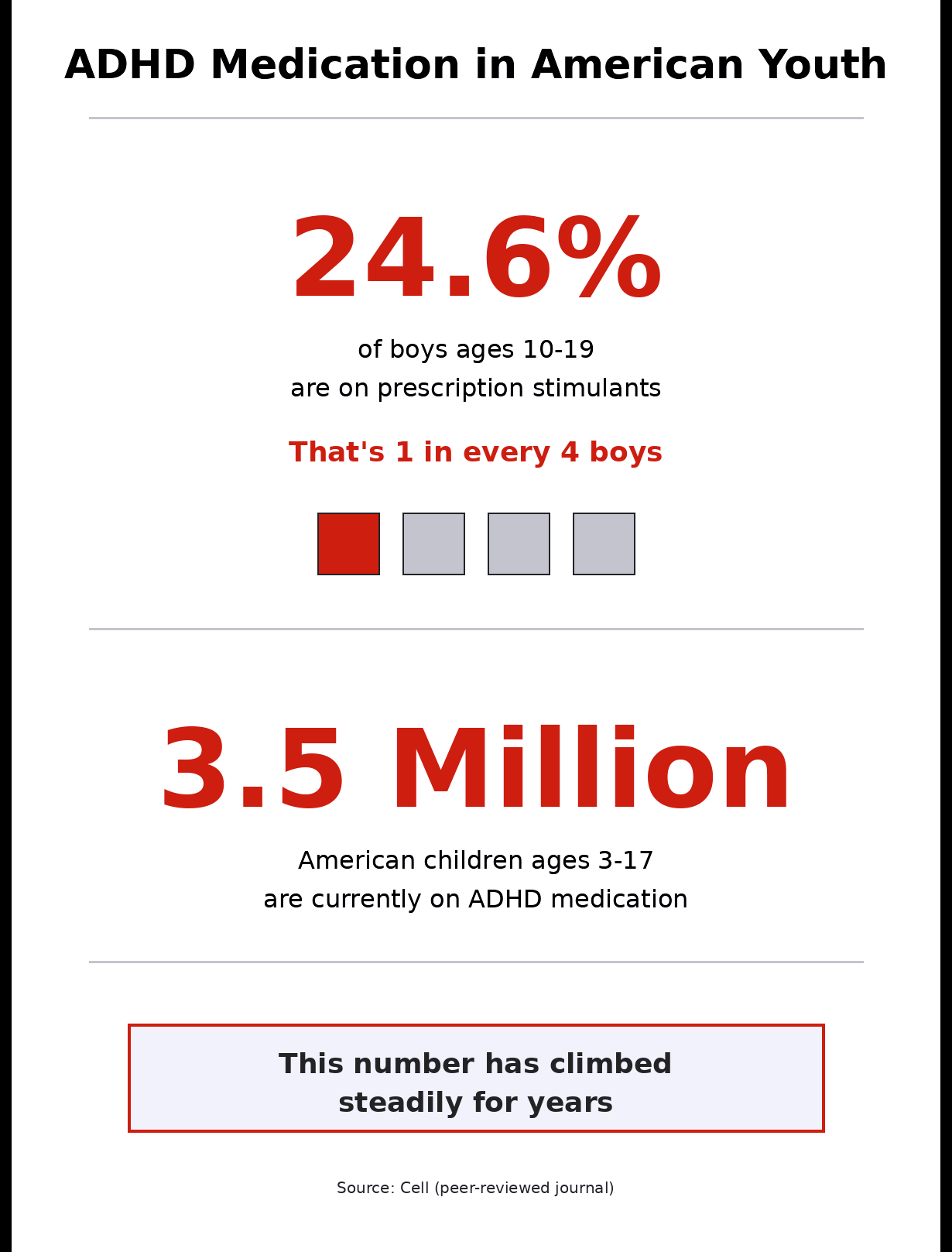
According to the full peer-reviewed paper in Cell, up to 24.6% of boys ages 10–19 are on a prescription stimulant. 3.5 million American children between the ages of 3 and 17 are currently on ADHD medication, a number that has climbed steadily for years.

Meanwhile, The New York Times Magazine published an investigation that is equally difficult to read and equally impossible to ignore. (Paywalled - free summary here via the PSSD Network.)
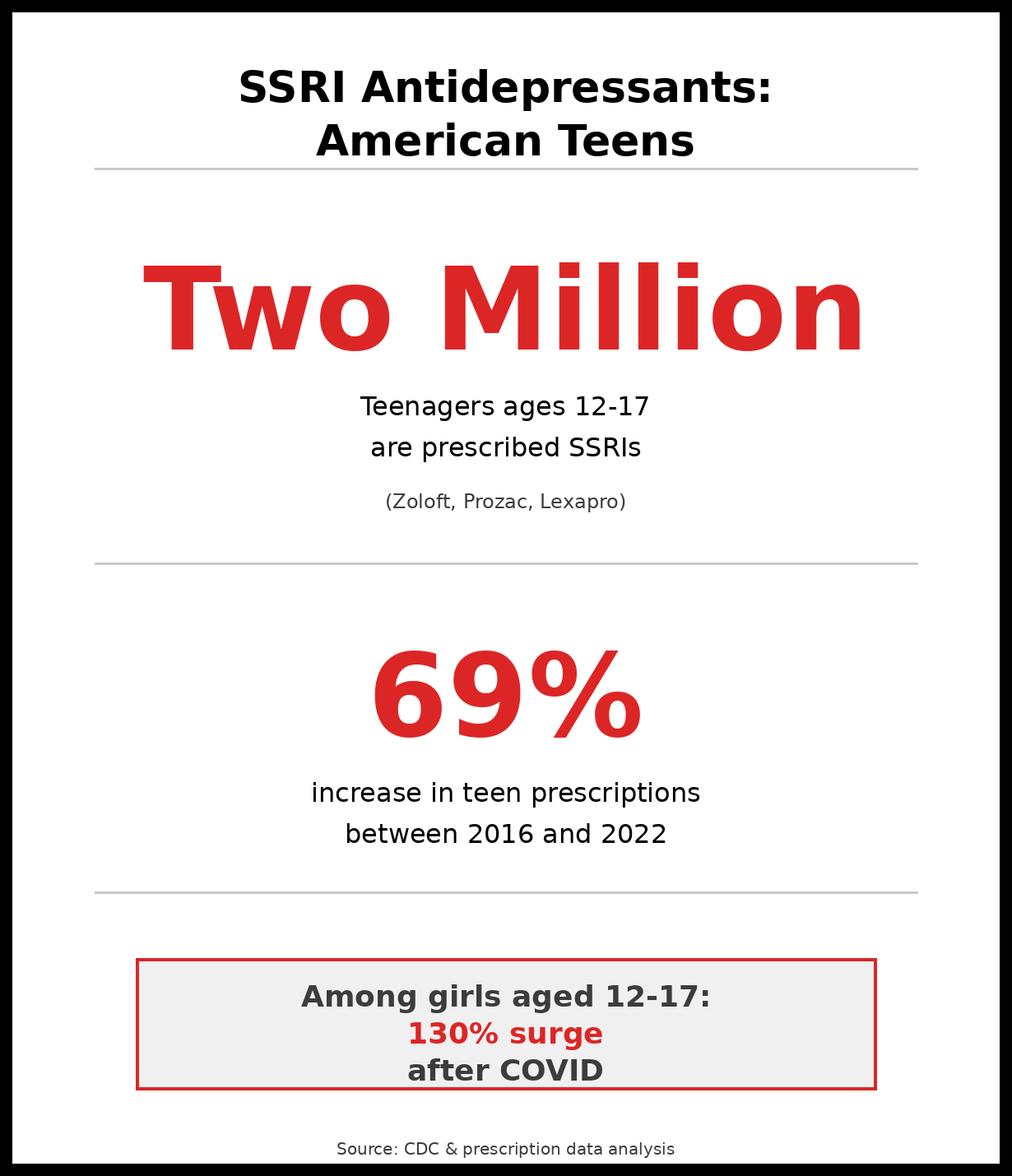
SSRIs, antidepressants like Zoloft, Prozac, and Lexapro, are now prescribed to roughly 2 million teenagers between the ages of 12 and 17. Prescriptions to teens climbed 69% between 2016 and 2022. Among girls aged 12 to 17, that number surged 130% after COVID.
For many of these young people, no one mentioned what the research on adults has shown for years: SSRIs cause sexual side effects in 30 to 80 percent of people who take them. Diminished libido. Genital numbness. Muted or absent orgasm. Emotional blunting so thorough that patients describe feeling nothing, not just less sad, but less human.
What the Times investigation added, and what makes this story so urgent, is that for a significant number of people, these effects don’t end when the prescription does. The condition has a name: Post-SSRI Sexual Dysfunction, or PSSD. Young people who started these drugs in adolescence are now in their twenties, thirties, and forties, and they still haven’t recovered.
There is currently no dedicated research studying how SSRIs affect adolescents during the critical developmental window when sexuality naturally forms. None. The studies exist for adults. For children and teens, who are being prescribed these drugs in record numbers, there is a research vacuum. And regulators are only now beginning to acknowledge the problem exists.
As the Times investigation found: adults on SSRIs experience negative sexual side effects 30–80% of the time, but most prescribers don’t mention this during informed consent, citing concerns about “patient compliance.”
If you want to understand how we got here, how psychiatric medication of children became routine, normalized, and defended, watch this documentary by my friend and fellow filmmaker Wendy Ratcliffe:
Medicating Normal — Full Documentary (YouTube)
Medicating Normal tells the stories of ordinary people, veterans, a college student, a new mother, who were prescribed psychiatric medications for everyday struggles and then couldn’t get off them. It is essential viewing for any parent navigating this system.
Neither of these studies means that every child on ADHD medication should stop taking it, or that SSRIs are never appropriate. But they do mean that the blanket, reflexive prescribing culture we have normalized around children’s mental health, the kind that pathologizes a fidgety eight-year-old or a sad teenager and reaches for a pill before asking harder questions, is not based on the science it claimed to be.
Before you fill a prescription, ask your child’s doctor:
→ Has my child been evaluated for sleep problems? Sleep deprivation and ADHD look nearly identical. The Cell study found that stimulants essentially mimic the brain effects of adequate sleep. Fix the sleep first.
→ What non-medication interventions have we tried? Exercise, structured routine, dietary changes, behavioral therapy — these have evidence behind them and should come before a stimulant.
→ What are the sexual and developmental side effects of this SSRI for adolescents specifically? If your doctor doesn’t know or doesn’t mention PSSD, push harder. A 30–80% rate of sexual side effects in adults is not a footnote.
→ What does the exit plan look like? A 2019 survey found that most children put on SSRIs at the start of the study were still taking them five years later. That was never the intent.
Children are not small adults with convenient diagnoses. They are developing human beings in the middle of forming their brains, their identities, their sense of themselves in the world. That is not the moment to experiment with their neurochemistry based on assumptions that have now been scientifically challenged.
Restoring childhood means insisting that childhood be protected, including from the well-meaning systems that, in trying to help, can cause harm that lasts a lifetime.
If this post matters to you, share it with a parent who needs to see it before their next doctor’s appointment.
Sources: NIH: ADHD Medications Stimulate Alertness, Motivation · Cell (peer-reviewed full paper) · PubMed/PMC full text · NPR coverage · ScienceDaily · NYT Magazine: SSRIs and Teens · PSSD Network NYT summary (free) · MedShadow Foundation: SSRIs and Adolescent Development · Medicating Normal documentary