


A federal judge in Massachusetts could rule any day on one of the most consequential children’s health decisions in a generation: whether independent science can override institutional politics when it comes to our kids. Here’s why I’m hopeful, and why this moment is bigger than one court case.
The Schedule Nobody Was Allowed to Question
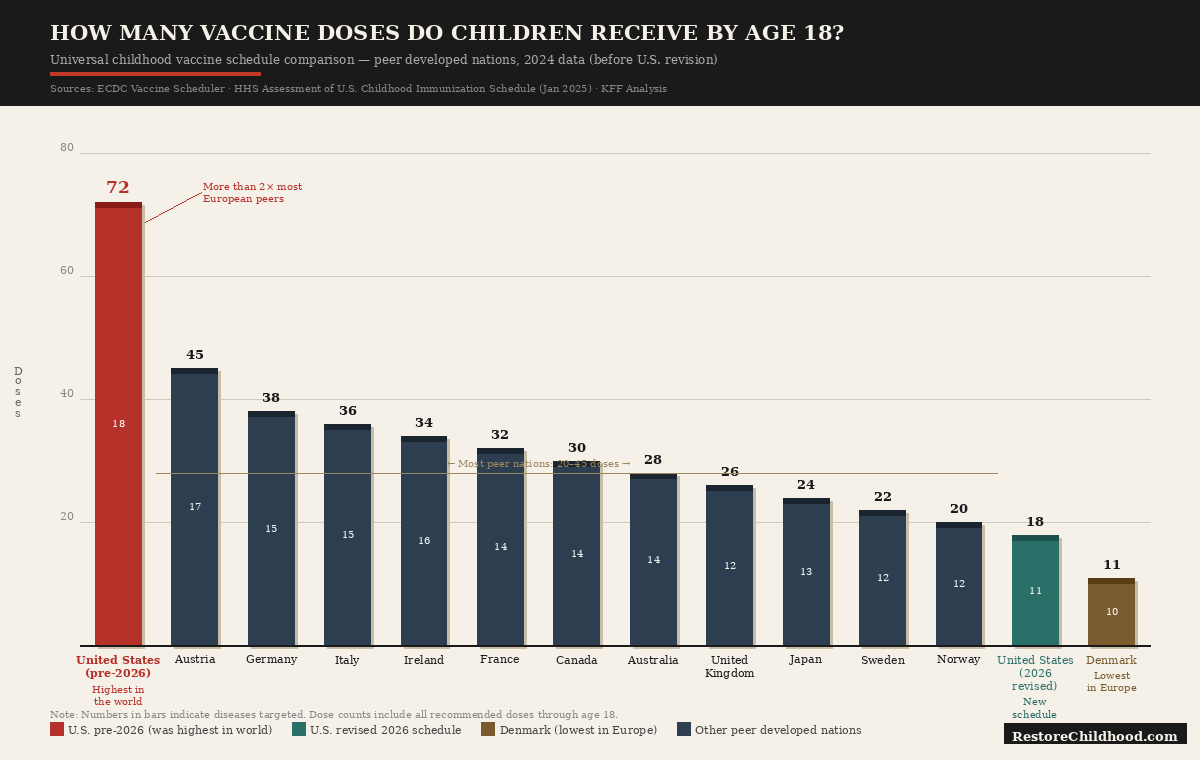
In the early 1980s, American children received vaccines against 7 diseases. By 2025 that had ballooned to 18 diseases — 72 total doses by age 18 — added incrementally over decades with virtually no comparison to what peer nations were doing.
Germany: 15 diseases. France: 14. Italy: 15. Austria: 17. UK: 12. Sweden, Finland, Norway: roughly a dozen each. Denmark, which consistently ranks among the world’s healthiest nations: 11 doses targeting 10 diseases — with no mandates, no coercion. As KFF noted, none of the other 29 European CDC member countries matched America’s former schedule for breadth. We were the outlier — not at the top of a global consensus, but outside it entirely.
When HHS revised the schedule to 11 universally recommended vaccines on January 5th, we didn’t become reckless. We came into alignment with where most of the developed world already was. What expanded the schedule so dramatically wasn’t rigorous science — it was the incremental accumulation of recommendations by a committee with financial ties to vaccine manufacturers and limited transparency. That’s not a conspiracy theory. It’s how the system was built.
“I think one of the reasons Denmark may do a better job at making their vaccine recommendations,” she told the committee, “is that it’s not a politicized discussion.”

Denmark’s Real Lesson: Independent Science
At the center of this debate is my friend Dr. Tracy Beth Høeg — dual US-Danish citizen, physician, and PhD in epidemiology from the University of Copenhagen, now acting director of the FDA’s Center for Drug Evaluation and Research. In December she presented at ACIP comparing the two countries’ approaches. Her argument wasn’t anti-vaccine — it was pro-science.
“I think one of the reasons Denmark may do a better job at making their vaccine recommendations,” she told the committee, “is that it’s not a politicized discussion.” She described Denmark’s Statens Serum Institut — its independent government vaccine body — as a model of transparent deliberation, honest acknowledgment of uncertainty, and willingness to reverse recommendations when evidence warrants it. The SSI added pertussis and RSV vaccines during pregnancy in 2024 and 2025. It is not anti-vaccine. It is simply independent. That’s the lesson — not which specific shots Denmark gives, but how they decide.
The Chronic Disease Crisis Nobody Would Discuss
If we had the most aggressive childhood vaccine schedule in the developed world, why are American children so chronically sick?
The White House MAHA Commission report found that over 40% of America’s 73 million children have at least one chronic health condition. Autism has gone from 1 in 150 children in 2000 to 1 in 31 today — a nearly five-fold increase in one generation. One in 9 has ADHD. One in 12 has a food allergy.
The causes are almost certainly multiple — ultra-processed food, environmental toxins, microbiome disruption, and possibly a range of immune system stressors. But the point is that something has gone profoundly wrong with children’s health during a period when our medical institutions were telling us everything was fine and that anyone who asked questions was dangerous.
That posture — “trust us, don’t ask” — is not science. It is authority cosplaying as science. For the first time, this administration is treating the chronic disease epidemic as the crisis it is and commissioning real answers.
While the AMA and the American Society of Plastic Surgeons both moved this month to defer gender surgeries for minors until adulthood — citing insufficient evidence — the AAP refused to follow, calling proposed restrictions a ‘baseless intrusion into the patient-physician relationship’ and declining to participate in HHS’s own evidence review.
The AAP Has Lost the Right to Claim the Science
The American Academy of Pediatrics — which filed the lawsuit now before Judge Murphy — presents itself as the voice of evidence-based medicine for children. Its recent record tells a different story.
School closures: The AAP provided cover for decisions that kept millions of children out of school, despite mounting evidence of catastrophic harm. A Harvard study of 180,000+ California children later confirmed that school reopening reduced mental health diagnoses by 43%. My documentary 15 DAYS documents what that cost looked like up close.
Masking children: The AAP supported masking toddlers despite no randomized controlled trial evidence that child masking reduced transmission. The UK, Sweden, and Denmark never masked children and saw no worse outcomes.
COVID vaccines: The AAP pushed COVID vaccine recommendations for children in the lowest risk categories, including those with robust natural immunity. Denmark removed the COVID shot from its childhood schedule for healthy children under 18.
Pediatric gender medicine: The AAP still endorses puberty blockers and surgical interventions for minors even as the UK’s Cass Review — the most rigorous independent review ever conducted — concluded the evidence base is “remarkably weak.” The UK, Sweden, Finland, Denmark, and Norway have all now restricted or banned these interventions for minors.
While the AMA and the American Society of Plastic Surgeons both moved this month to defer gender surgeries for minors until adulthood — citing insufficient evidence — the AAP refused to follow, calling proposed restrictions a 'baseless intrusion into the patient-physician relationship' and declining to participate in HHS's own evidence review.
This is the organization now suing to preserve a vaccine schedule built by the same captured process it has championed for decades.
We’re Finally Following the Science
Real science is transparent about uncertainty. It doesn’t pretend advisory committees are infallible simply because they carry institutional prestige. What I’m watching in this moment is whether America can return to the kind of independent process the best countries in the world never abandoned — one that answers to the health of children, not the institutions that profit from them.
A federal judge is deciding whether the Administrative Procedure Act means what it says. That’s the narrow legal question. The broader one — whether our children’s health policy will finally be governed by transparent, independent science — is the question of this entire era.
I think we’re getting closer to the right answer.
And in case you missed it last week, here’s an important study that Restore Childhood helped fund looking at the benefit-risk analysis of Moderna’s COVID-19 vaccine, for 18–25-year-old males.
The Study Nobody Wanted to Fund, So We Did

When an institution won’t ask hard questions, someone has to.